

Learn How to Write Copy – Write Content Like a Pro: 9 Easy Steps to Get a Copyright. If you want to boost sales, write better headlines, or connect with your audience, these tips can help. You’ll discover practical ways to understand your readers and create clear, engaging content.
You’ll also find out how to write strong calls to action, use storytelling, and add SEO techniques to make your writing stand out. This guide is ideal for beginners looking to improve their skills and achieve better results.
Copywriting might look confusing at first, but it’s not as hard as it seems.
Good copywriting uses a few simple techniques that can boost sales, generate leads, and drive more traffic to your website. Sometimes, just changing a few words makes a big difference.
Even if you’re new to copywriting, you can learn and use these strategies successfully.
If you follow these steps
With some practice and focus, you can really improve.
These tips are simple, easy to remember, and anyone can use them if they’re willing to try.
How to Write Copy – Write Content Like a Pro: 9 Easy Steps to Get a Copyright
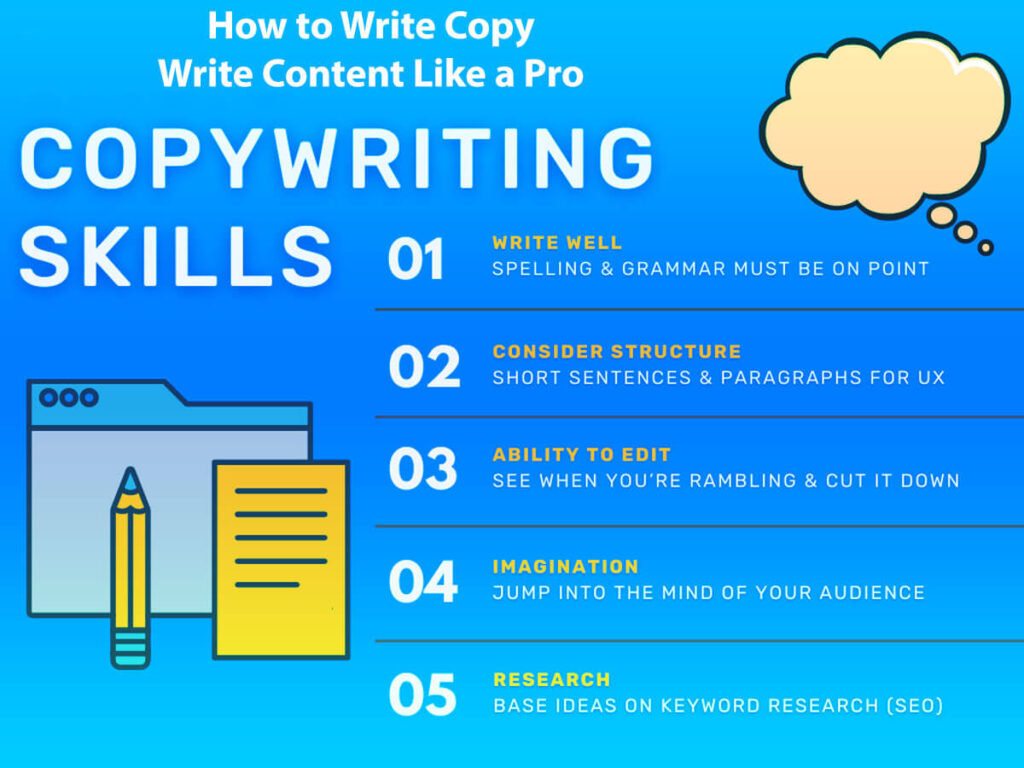
Copywriting Tips: Get practical advice on how to write text that grabs attention and encourages people to take action.
How to Write Copy: Learn the basics and key techniques you need for effective copywriting.
Writing Persuasive Content: Discover ways to influence readers and motivate them to take action.
Headline Writing Strategies: Learn how to write headlines that catch attention and make people want to read more.
Improve Sales Copy: Find out how to make your sales messages connect with customers and boost your sales.
Content Writing Steps: Follow a step-by-step process to create content that works for your audience.
Copywriting for Beginners: Start here if you’re new to copywriting and want to learn the basics.
Boosting Conversions with Copy: Try these tips to improve your copy and get more people to take action.
Problem-Solution Copywriting: Show how your product or service solves a problem your audience faces.
Writing Effective CTAs (Calls to Action): Learn how to write calls to action that encourage readers to respond or buy.
Copywriting Frameworks: Use proven structures to make writing effective copy easier.
Writing for the Target Audience: Learn how to understand your readers and write content that meets their needs.
Clear and Concise Copy: Learn how to write and get your message across without extra fluff.
SEO Copywriting Techniques: Discover how to add SEO to your writing so more people can find your content online.
Engaging Content Writing: Find ways to keep your readers interested from start to finish.
Direct Response Copywriting: Write messages that encourage readers to act right away.
Scannable Content Tips: Learn how to format your writing so readers can quickly find the main points.
Storytelling in Copywriting: Use stories to make your content memorable and connect with your audience.
Copywriting Best Practices: Follow these key guidelines to write strong, effective copy.
Writing Benefit-Driven Copy: Show customers the benefits and value your product or service provides, not just its features.
Highlight the Focus on Headlines
Begin by spending time on your headlines, since they’re the most important part of your copy.
Of all the things you can do, your homepage headline is the quickest way to improve your results.
One good headline can increase free-trial signups by 30%, while a bad one can make them drop.
I’ve seen this happen many times. Headlines placed in the right spots can really boost conversions.
Here are the main places where you should focus on improving your headlines:
Homepage headline: This is usually the first thing people see, so make it strong.
Email subject lines: These decide if your emails get opened or skipped.
Main headline on landing or sales pages: This matters most because it’s where people decide to buy or sign up.
Campaign headlines in ads, social media, and emails: Catchy headlines here can really boost engagement.
Product names and first description lines: Make them memorable and show what the product is about.
There’s a lot of copywriting advice out there, but after ten years in the field, I can say most of it isn’t useful.
Instead, put most of your effort into making your headlines better.
If you want a good starting point, try reading “Great Leads.” It has helpful tips for writing strong headlines.
Quick Headline Guidelines:
Make specific promises: Use numbers when you can to strengthen your claims.
Front-load the benefits: Start with phrases like “Achieve X without Y” or “Complete A in B minutes” to grab attention.
Identify your target audience: Make it clear who will benefit, for example: “For founders who…” or “For HR teams seeking…”
Experiment with contrasts: Show the benefits alongside common worries, compare speed with certainty, and discuss outcomes versus processes.
Generate 15-25 variations: Don’t pick your final version too soon. Usually, your first five ideas aren’t your best ones.
Write as if You’re Conversing with a Friend
A common mistake in copywriting is getting overly fixated on the concept of “voice.”
Many writers end up sounding too formal and stiff, which can hurt clarity, even in professional writing.
To fix this, imagine you’re texting a close friend who asked for your advice. You wouldn’t use business jargon in that chat, so don’t use it here either.
Keep your writing simple, direct, and clear. I also prefer content that’s easy to read and interesting.
Try to write so that a 4th- to 6th-grader could understand it. The goal isn’t to follow a strict rule, but to make your writing easy to read. Usually, it means more people will read and buy.
Friend-Style Writing Checklist:
Use short sentences: Try to keep your sentences under 20 words so they stay clear.
Favor strong verbs: This makes your writing more vivid and helps readers picture what you mean.
Eliminate unnecessary qualifiers: Only use words like “just,” “really,” or “very” if they add something important.
Stick to one idea per sentence: Stick to one idea in each paragraph to make your writing easier to follow.
Use the Problem/Solution Structure
You’ll find lots of copywriting frameworks out there. AIDA (Attention, Interest, Desire, Action) is a classic example.
Experienced copywriters know these structures well and often create their own versions. But you don’t need a complicated framework to get good results.
If you’re not sure what to do next, go back to the simplest structure you can.
Clearly articulate the problem in your reader’s language and tone.
Present your product or service as the compelling solution to that problem.
This method might seem simple, but it works very well. It may not be as fancy as what expert copywriters do, but it can still boost your sales and conversions.
Since much of the copy today isn’t great, being clear and relevant will help you stand out. Start with the problem, then share your solution.
Applying the Problem/Solution Framework:
Problem: “Our proposals take a week and often go unnoticed.”
Solution: “Utilize a 3-slide proposal template that clients can sign in just 24 hours.”
Problem: “New representatives struggle to manage overwhelming information.”
Solution: “Provide a structured 7-day onboarding plan with one actionable task assigned each day.”
If you use these strategies in your copywriting, you’ll build a solid base for writing great messages and seeing real business results.
Bring Your Message Down to Earth
In the world of marketing and copywriting, a familiar piece of advice often rings true: “sell benefits, not features.”
This advice is helpful, but beginners sometimes go overboard, focusing on benefits that sound too big or too vague.
Phrases like “Grow your business! Find love! Lose weight! Make more money!” might sound appealing at first, but they usually don’t have the detail or depth needed to really connect with people.
To improve your copy, keep your messaging realistic.
Focus on clear, specific improvements your audience can expect soon after using your product or service, rather than big, vague promises.
For example, consider someone who started a program called Zero to Launch, which later became Earnable.
In a crowded market full of similar sales promises, many offers start to sound the same.
Instead of starting with a cliché like “Start the business of your dreams,” the sales page began with a real, relatable situation.
It connected with people by describing the frustration of a tiring work schedule, the stress of needing a steady paycheck, and the real desire for more freedom.
It promised potential customers they could build a business that would “pay you to live the life you’ve always wanted.”
This approach works because it gives potential customers a realistic picture. Imagine blocking off whole weeks on your calendar and still seeing your revenue grow.
Picture waking up to new orders that came in overnight or having weekends without money worries. These specific examples are much more powerful than vague promises.
Instead of making vague promises, make sure your messaging is clear and concrete.
Consider these real-world comparisons:
Vague: “Improve team productivity.”
Specific: “Eliminate tedious 60-minute status meetings and swap them for a quick 5-minute daily asynchronous check-in.”
Vague: “Get healthier.”
Specific: “Add a quick, 10-minute no-equipment workout to your morning routine before your coffee kicks in.”
Vague: “Save money.”
Specific: “Learn how to negotiate your internet bill in just 7 minutes using this proven script.”
Borrow Structure for Creative Inspiration
If you hit a creative block, it’s fine to borrow structure from successful examples in your field.
Great copywriters don’t create everything from scratch. They often get ideas from proven headlines, interesting angles, and sales funnels that have worked before.
But remember, you shouldn’t copy someone else’s words directly.
Instead, use their structure as a base and add your own voice and ideas to make something new and interesting.
Here are some valuable sources to explore for structural inspiration:
Headlines from popular magazines: Publications like tabloids, People, and Vogue are great at creating headlines and stories that grab attention.
Public swipe files: collections of successful ads and sales pages. They’re great for finding angles and formats that work.
Ads that catch your eye: Click through and examine the entire user journey. Save screenshots of parts you find interesting for later.
It’s best to avoid big brand campaigns from companies like Coca-Cola or Ford.
Their huge budgets and long-term goals mean their strategies don’t usually work for direct-response marketing.
Instead, learn from direct-response marketers who depend on clear results and measurable sales.
Speak Your Customers’ Language
One of the best ways to improve your messaging is to use the exact words your customers use. When you do this, prospects might think:
“How do they understand me so well?”
Building this connection can really boost your conversion rates.
You don’t need to make up new words or jargon. The key is to listen closely to your audience.
Collect phrases directly from your customers, or even from your competitors’ customers if you’re starting.
Here are some reliable resources to extract this invaluable language:
Customer surveys and post-purchase polls: These provide direct user feedback and offer plenty of useful language.
Recorded sales calls and support chats: These show you the words your audience uses in real conversations so that you can use that language in your messaging.
Reviews on sites like Amazon or app stores: People share their honest opinions here, giving you insight into their language and concerns.
Threads on Reddit and forums: These places are full of real discussions about your audience’s concerns, desires, and problems, so you can see what matters to them.
Comment threads on social media: These show the words your audience uses and the main issues they care about.
Pay special attention to common phrases, especially those related to pain points, fears, and goals.
For instance, in my experience with information products, students frequently mentioned their desire to leverage Facebook ads to “turn $1 into $2.”
If I created that program, I’d use that simple, powerful phrase as the headline for all my messaging. It’s direct, clear, and really connects.
Collect the language your market uses and work it into your headlines, bullet points, and calls to action.
This approach makes your messaging stronger and helps you connect with your audience, so they feel understood and valued.
If It Doesn’t Work, Change the Offer
Take the time to review every line of your sales pages if you want your marketing to succeed.
Of all the parts of a strong sales strategy, your core offer matters most.
Your core offer shows what makes you different and what you promise your audience.
If you get this right, you build a strong base that can boost your revenue, sometimes by as much as 10 times.
But if your offer misses the mark, you might see poor results and lose out on chances to grow.
If your copy isn’t working, don’t waste time changing small things like adjectives or style.
Focus on reworking your main offer instead. Try different approaches until you find one that truly connects with your audience. This step is key to your success.
You can use this idea in both your marketing and your overall business decisions:
Marketing: If your lead magnet isn’t performing as intended, consider a thorough revamp.
Try out new formats that are different from what you’ve done before.
For example, you could offer checklists for quick wins, interactive workshops, easy-to-use toolkits, helpful calculators, or free audits with personal feedback.
Each change should be a clear shift from your past efforts to grab attention.
Business: If your sales have stalled, it’s time to try something new.
You might repackage your product to better showcase its value, test new pricing for different budgets, offer a done-for-you service, or target new groups who could use your product. Stay flexible.
How to Write Like a Pro
Professional writers don’t need fancy words. Instead, they focus on revising their work to make it clear and effective.
Here’s a simple process you can use to improve your writing:
Draft Quickly: Start by writing a rough version of your content without interruptions. Get your ideas down on the page without overthinking or self-editing.
Structure: Once you have a draft, rearrange your content to make it flow logically. Guide your reader from the problem to your solution, back it up with evidence, and end with a clear call to action.
Enhance Clarity: Edit your sentences to be short and direct. Use strong verbs instead of words like “is,” “are,” or “have” to make your writing more lively.
Add Specifics: Use real numbers, names, timeframes, and examples to make your message more believable.
Find Your Voice: Read your writing out loud to spot filler words, clichés, or weak language. Cut out anything that doesn’t add value.
Here are some practical writing tips you can implement immediately:
Try starting sentences with “Because” to give readers a reason to keep going.
Use “you” more than “I” to keep the focus on your reader and make the content feel personal.
Don’t just list features—show real results. For example, say “Store 10,000 photos on day one” instead of “5 GB of storage.”
Share strong proof early in your copy. Use stats, real testimonials, screenshots, or short demo GIFs to build trust.
End with a clear next step and a strong reason for your reader to act now.
How to Create Content That’s Easy to Scan
Most readers won’t read every word—they’ll scan your content first.
Your goal is to help them quickly see the value and guide them to take action.
The Scannability Playbook:
Lead with the Takeaway: Begin each section with a short sentence that tells readers what they’ll get.
Descriptive Subheads: Add clear subheadings every 150-250 words. Treat them as mini-promises, like “Reduce onboarding from 14 days to just 3.”
Concise Paragraphs: Keep paragraphs short—just 1 to 3 sentences. Break long blocks of text into shorter sections to make them easier to read.
Use Lists: Turn steps, comparisons, or examples into bullet points or numbered lists for clarity.
Parallel Bullets: Start each bullet with the same type of word and structure. Makes your points easier to follow (for example, “Action verb + outcome”).
Front-Load Keywords: Put the most important words at the start of your sentences or bullets so scanners catch the key info right away.
Sparingly Bold for Emphasis: Only bold key phrases. Too much bolding can confuse readers and weaken your message.
Employ Data and Specifics: Use numbers like percentages, timeframes, or costs to grab attention and build trust.
Micro-CTA at Section Ends: End each section with a short call to action that tells readers what to do next.
10-Minute Scannability Check
To check if your content is easy to scan, try these steps:
Find three long paragraphs and split each into two or three shorter ones to make them easier to read.
Turn one detailed explanation into a short, numbered list of 3 to 5 steps so readers can follow it easily.
Add a clear subheading above any section longer than 200 words so readers know what it’s about right away.
Bold only one key phrase per section to highlight the main takeaway.
Replace vague statements with real numbers or examples to make your point clearer and stronger.
Use these strategies to make your content more effective, engaging, and easier for readers to use.
Before/After Example
Before: “Our platform helps teams collaborate better by providing tools that streamline workflows and improve productivity across departments.”
After:
Make daily communication easier by cutting status meetings down to 5 minutes. Use quick daily check-ins so everyone stays up to date without long interruptions.
Speed up project delivery with a single board where your team can access, assign, and review tasks, share files, and get approvals—all in one place.
Spot and fix workflow problems quickly with detailed progress reports that highlight issues in need of attention. Helps your operations run more smoothly.
Reusable Section Template
Hook: Start with a strong, one-sentence promise that clearly explains the main benefit.
What You’ll Get:
Benefit 1: List 2 or 3 key advantages in short bullet points, like saving time, working more efficiently, or making teamwork easier.
Benefit 2: Show how these benefits will directly improve productivity or results for your reader.
Benefit 3: Explain how these advantages can help achieve clear, measurable success.
Steps: Provide a simple, numbered list that guides the reader through each step of the process. Make sure every step is clear and easy to follow.
Result: Describe a clear outcome that shows the benefits of taking action. Use data or testimonials to back up the positive results.
Next Action: End with a clear call to action that tells the reader exactly what to do next. Make it easy to understand and follow.
Try It Now: Pick a long section on your website and use this structure to make it clearer and more engaging. Add a small call to action at the end to encourage your audience to act right away.
How to Create Engaging Content
To boost engagement, use a clear sequence: start with a hook, give a payoff, show proof, and suggest the next action. Repeat this cycle in short, focused sections for the best results.
Employ the following strategies to enhance engagement:
Start with something attention-grabbing, like a big change in numbers, a strong customer quote, or a vivid scene that pulls the reader in.
Ask a question that sparks curiosity, then answer it soon after to keep readers interested.
Switch between telling a story and sharing quick, actionable tips. Keep each part short—just 1 to 3 sentences—to stay clear and engaging.
Tackle possible reader concerns head-on, such as:
“What if our data is messy?”
Then, quickly show an example of how your solution can handle these challenges.
Encourage readers to take small steps, like picking one thing to try today. Helps them feel engaged and see progress.
Simple Hook Formulas for Your Content:
“Most people do X. Here’s what the top 1% do instead.”
“I changed one input and achieved a Y result in Z days.”
“If you focus on fixing A, then B and C will fall into place on their own.”
CTAs That Seal the Deal
Your call to action (CTA) is key to getting conversions. Make sure it’s clear, simple, and directly tied to a user benefit.
Where to Place CTAs:
Above the fold: Feature the primary CTA prominently near the headline to capture the attention of potential buyers who are ready to take action.
Mid-page: Place the CTA after your first proof, like a strong customer testimonial, an impressive stat, or a demo GIF that shows your product works.
End of page: Summarize the value before your CTA. Add risk-reversal elements to build trust and ease concerns.
Mobile: Use a sticky CTA at the bottom with short text. It should stay visible but not distract from your main content.
What the Button Should Display
Combine the result and next step in your CTA: Use phrases like “Start my free trial,” “Get my proposal,” or “Book my 15-minute demo” to clearly show the benefit.
Use first-person language: For example, “Start my trial” usually works better than “Start your trial.”
Remove any confusion: Add a short note next to the button, such as “No credit card required,” “You can cancel anytime,” or “Takes only 60 seconds,” to reassure users.
Match your CTA to where the user is in the funnel:
Top of the funnel (TOFU): “Get the guide.”
Middle of the funnel (MOFU): “See it in action.”
Bottom of the funnel (BOFU): “Start my free trial,” or “Get pricing.”
Make Saying “Yes” Easy
Using risk-reversal strategies can increase the likelihood that users convert. Try offering a free trial, a satisfaction guarantee, the option to cancel anytime, a sample chapter, or a sandbox demo.
Boost trust by placing a strong testimonial or key statistic near your CTA—within 50 to 100 pixels—to increase conversions.
Focus on one main action: If you need secondary links, keep them as simple text links and place them so they don’t distract from your main CTA.
Keep forms short: Ask only for what you need at first, like an email address. Gather more details later as users get more involved.
CTA QA Checklist
Quick Scanner Recognition:
Is the Call to Action (CTA) designed to be instantly recognizable by a scanning eye within one second?
Matters because it helps users quickly understand what the button does, which reduces confusion.
A good CTA should be easy to spot and placed where it grabs attention right away.
Outcome-Focused Copy:
Does the button text clearly show what the user will get after clicking, instead of just stating the action?
For instance, instead of “Download Now,” using “Get Your Free E-book” emphasizes what the user gains.
Focusing on what users want makes the CTA more appealing and easier to relate to.
Supporting Elements:
Is there supporting information nearby, such as statistics, testimonials, or well-known logos, that make the CTA more trustworthy?
Adding a risk-reversal statement, such as “No obligations” or “100% money-back guarantee,” helps reassure users and reduces their hesitation to act.
Singular Mobile Focus:
On mobile devices, is there only one primary CTA displayed on each screen?
This design choice reduces distractions, helping users focus on the main action and boosting engagement and conversions.
Tracking Engagement Metrics:
Are engagement metrics such as click-through rates (CTR) and post-click conversion rates monitored separately?
Tracking these metrics gives you useful insights. CTR shows initial interest in the CTA, while post-click conversion rate measures real engagement and completed actions. Reviewing this data helps you improve your results.
Quick Copy Swipes
Free Trial Language:
Rather than simply stating “Start my 14-day free trial,” consider enhancing it with a subtext like, “No credit card required.
Cancel anytime.” This extra detail reassures users that they can try the product without any financial risk, making it easier for them to get started.
Demo Duration Specification:
Instead of a generic “Book a demo,” use more precise wording such as “Book a 15-minute demo.”
Helps users know how much time they’ll need, easing worries about long meetings.
Value-Added Downloads:
Instead of just saying “Download,” try “Get the 7-step template.” Tells users exactly what they’ll get, making the offer more appealing.
Combine Design and Copy for Better Results
Good design helps make your message clear and your call to action stand out.
Combine visuals and text so they work together. Creates a smooth, welcoming experience that encourages users to interact and take action.
Create a One-Screen Story
Clear Hierarchy:
Arrange your content in a clear order. Begin with a headline that grabs attention and promises value, then add a subheadline that briefly explains how you’ll deliver on that promise.
Show proof, like client logos, important stats, or strong testimonials. End with a clear, easy-to-see CTA that encourages users to act.
Focus on One Idea at a Time:
Use separate content blocks with plenty of space around each idea. This helps users focus on one message at a time and prevents things from feeling crowded.
Visual Anchors:
Add simple, clear icons or images to label each section.
These visuals should be easy to understand and match the text, helping users stay focused.
Typography That Sells
Effective Contrast:
Use a type scale with 3 or 4 levels, like H1 for headlines, H2 for subheadlines, body text for paragraphs, and captions for extra details.
Make sure your text is big enough to read easily on both desktop and mobile screens.
Optimal Line Length:
Try to keep each line of body text between 45 and 75 characters. Makes reading easier and more comfortable for users.
Button Readability:
Use sentence case for button text instead of all caps. Makes it easier to read and understand.
Also, make sure buttons have clear focus states so everyone can use your CTAs easily.
Layout Patterns That Drive Conversions
Natural Eye Movement Patterns: To grab users’ attention, design your layouts to match how people naturally scan a page.
Using Z-pattern and F-pattern layouts works well. With a Z-pattern, people usually look from the top left to the top right, then move down to the left, and finally across to the right.
Place important elements, such as headlines and CTAs, along these paths so users see them as they move through the page. Helps boost engagement.
Proximity of Proof to Promises: To make your claims more believable, place supporting materials like company logos, customer ratings, testimonials, or statistics right below the promises they relate to.
Keeping proof of your promises close builds trust and helps users quickly decide in your favor.
Directional Cues: Adding visual cues that point users to CTAs can boost your conversion rates.
You can use arrows, lines, or even images where people are looking at the CTA to guide attention.
These subtle hints help users know where to go next, making the site easier and more pleasant to use.
Strategic Use of Whitespace: Often ignored, whitespace is a powerful tool that can improve your layout.
The idea is simple: if everything stands out, nothing really does.
Using whitespace wisely lets important elements like headlines and CTAs stand out, so users notice what matters most.
Images That Earn Their Keep
Outcome Visualization: Show the benefits of your product or service with visuals that highlight real results.
Dashboards with live data, before-and-after photos, or GIFs that show how you solve a problem can help users understand and stay interested.
Effective Use of Captions: Many readers tend to glance at captions before delving into the body of the text.
Think of captions as short headlines that quickly explain the main benefit or point of the image.
Good captions help users see why an image matters and can make them want to learn more.
Performance Optimization: Ensure your images load quickly to maintain a smooth user experience.
Compress images and enable lazy loading to speed up your site. Slow pages can make people leave and hurt your conversions.
Fast-loading pages not only improve user satisfaction but also bolster overall site performance in search engines.
Mobile-First, Accessible by Default
Convenient Thumb Reach: Since most people use their phones, put important CTAs where users can easily tap them with their thumbs.
Make buttons big enough to tap easily and place them where people naturally hold their phones.
Don’t put important actions near the edges or in hard-to-reach spots.
Readable Color Contrast: Follow color contrast guidelines to keep text easy to read in any lighting.
Make sure your text stands out from the background so it’s readable, even in bright light. Helps everyone use your site more easily.
Descriptive Alt Text and Labels: Always add clear, descriptive alt text to your images. It’s a key part of making your site accessible.
Alt text helps people using screen readers and gives everyone more context about your images.
Also, use clear labels for form fields and explain errors in plain language to avoid confusing users.
Copy-First Workflow (That Designers Love)
Message Structuring: Begin by outlining your content. Include a strong headline and three main benefits of your product or service.
Add at least one proof point, like a statistic or testimonial, to support your claims. Then finish with a clear call to action.
This structure makes sure your main message comes through clearly.
Wireframe Development: Start designing by sketching wireframes with simple boxes. Don’t worry about colors or style details yet.
Helps you figure out the content order and layout, so you can focus on how things work before thinking about looks.
Visual Pairing: Make your story stronger by matching each benefit with a visual, like an icon, screenshot, statistic, or other image that fits the message.
Pairing visuals with benefits makes your story clearer and helps users better understand your message.
Styling Considerations: Once your wireframe is set, add style elements with care.
Watch your spacing, text size, and button styles so they fit the content and keep your color palette simple and consistent.
Consistent style helps build your brand and gives users a smooth experience.
Five-Second Test: Test your design and content by asking someone new to look at it for five seconds.
Involves assessing whether they can immediately grasp the essence of the content—who it is for, what it offers, and what action should follow.
This quick test shows if your message is clear and interesting.
Result: Your main goal is to make a clear, compelling message that users notice, along with a design that naturally guides their attention.
A well-designed layout with strong visuals and text makes CTAs feel like the obvious next step, boosting conversions and making users happier.
How to Write Copy: Write Content Like a Pro – Frequently Asked Questions (FAQ)
1. What is copywriting?
Copywriting means writing text for ads or marketing to get readers to take action. It could be buying something, signing up for a newsletter, or clicking a link.
2. What are the essential elements of effective copy?
Good copy is clear, concise, and grabs attention. Here are the main things to include:
Headline: Grab attention and encourage readers to continue.
Engaging Opening: Start with something interesting to draw readers in.
Benefits: Show how your product or service solves a problem or makes life better.
Call to Action (CTA): Encourage readers to take the next step.
Sharing testimonials or case studies that highlight positive experiences can help build trust more easily.
3. How can I identify my target audience?
To gain a more comprehensive understanding of your target audience, research their age, gender, location, interests, and beliefs. Develop detailed buyer personas that embody your ideal customers, and customize your messaging accordingly.
4. What are some copywriting techniques?
Use active voice: This makes your writing clear and direct.
Incorporate storytelling: Telling a story helps people relate to your brand and feel connected to it.
Use scarcity and urgency: Limited-time offers can encourage readers to act quickly.
Make it personal: Use words like “you” and “your” to sound more conversational.
5. How do I improve my copywriting skills?
Read often: Look at different types of writing, like ads, blogs, and books about copywriting.
Practice writing: Try writing your own copy on different topics to get better.
Seek feedback: Share your work with others to get helpful suggestions.
Analyze successful copy: Look at ads and content that work well and figure out what makes them effective.
6. What tools can help with copywriting?
Thesaurus and dictionaries: Use these to find synonyms and learn what words mean.
Grammarly or Hemingway App: These tools help you check grammar and improve your writing style.
Google Trends: Use this to find popular topics and keywords your audience cares about.
Content management systems (CMSs) like WordPress help you publish and organize your content.
7. How can I ensure my copy is SEO-friendly?
Keyword research: Discover what keywords your audience is searching for.
Use keywords naturally: Add them to your headlines, subheadings, and main text, but don’t overdo it.
Optimize meta descriptions: Write short, interesting summaries that match your content and include your main keywords.
Internal and external linking: Link to other pages on your site and to helpful resources to boost SEO and help your readers.
8. How do I track the effectiveness of my copy?
Use analytics tools like Google Analytics to monitor things such as:
Conversion rates: How many people did what you wanted after reading your copy?
Bounce rate reflects how many visitors leave after viewing only one page, giving you a simple way to understand visitor engagement.
Engagement metrics: Time on page, how far people scroll, and click-through rates show which copy keeps readers interested.
If you master these copywriting tips, you’ll be able to write content that informs and gets results!
Copywriting Tips: Get practical advice on how to write text that grabs attention and encourages people to take action.
How to Write Copy: Learn the basics and key techniques you need for effective copywriting.
Writing Persuasive Content: Discover ways to influence readers and motivate them to take action.
Headline Writing Strategies: Learn how to write headlines that catch attention and make people want to read more.
Improve Sales Copy: Find out how to make your sales messages connect with customers and boost your sales.
Content Writing Steps: Follow a step-by-step process to create content that works for your audience.
Copywriting for Beginners: Start here if you’re new to copywriting and want to learn the basics.
Boosting Conversions with Copy: Try these tips to improve your copy and get more people to take action.
Problem-Solution Copywriting: Show how your product or service solves a problem your audience faces.
Writing Effective CTAs (Calls to Action): Learn how to write calls to action that encourage readers to respond or buy.
Copywriting Frameworks: Use proven structures to make writing effective copy easier.
Writing for the Target Audience: Learn how to understand your readers and write content that meets their needs.
Clear and Concise Copy: Learn how to write and get your message across without extra fluff.
SEO Copywriting Techniques: Discover how to add SEO to your writing so more people can find your content online.
Engaging Content Writing: Find ways to keep your readers interested from start to finish.
Direct Response Copywriting: Write messages that encourage readers to act right away.
Scannable Content Tips: Learn how to format your writing so readers can quickly find the main points.
Storytelling in Copywriting: Use stories to make your content memorable and connect with your audience.
Copywriting Best Practices: Follow these key guidelines to write strong, effective copy.
Writing Benefit-Driven Copy: Show customers the benefits and value your product or service provides, not just its features.
In Conclusion
To master copywriting, you need more than just persuasive writing. It takes a real understanding of your audience, skill in crafting strong messages, and a commitment to continually improving your writing.
Focus on clear language so your ideas are easy to understand and free of confusion.
It’s just as important to connect emotionally. Try to understand your audience’s feelings, wants, and challenges so your words feel personal to them.
This kind of connection can turn ordinary marketing messages into stories that motivate people to act.
A strong call to action is important, too. You want to do more than inform your audience—you need to encourage them to take the next step, like buying something, signing up, or sharing your content.
A clear, compelling call to action can significantly influence what your audience decides to do.
To get better at copywriting, keep practicing. Writing and revising often will help you build skill and confidence.
Ask peers or mentors for feedback. Their advice can give you helpful ideas to improve your writing.
Keep up with industry trends to make sure your copy stays relevant and effective.
You can do this by following copywriting experts, joining webinars, or reading new articles about consumer behavior and digital marketing.
If you stay dedicated, think strategically, and stay open to learning, you’ll develop your own voice as a copywriter and make a real impact with your words.
Enjoy the learning process and let your passion for writing show in everything you create.
How to Remove Reviews from Facebook: How to Delete a Review on Facebook in 5 Easy Steps
ReputationDefender Review: Details, Pricing, Services, Complete Guide, 8 Easy Steps
How to Fix Your Online Reputation: Manage Your Online Reputation in 8 Easy Steps