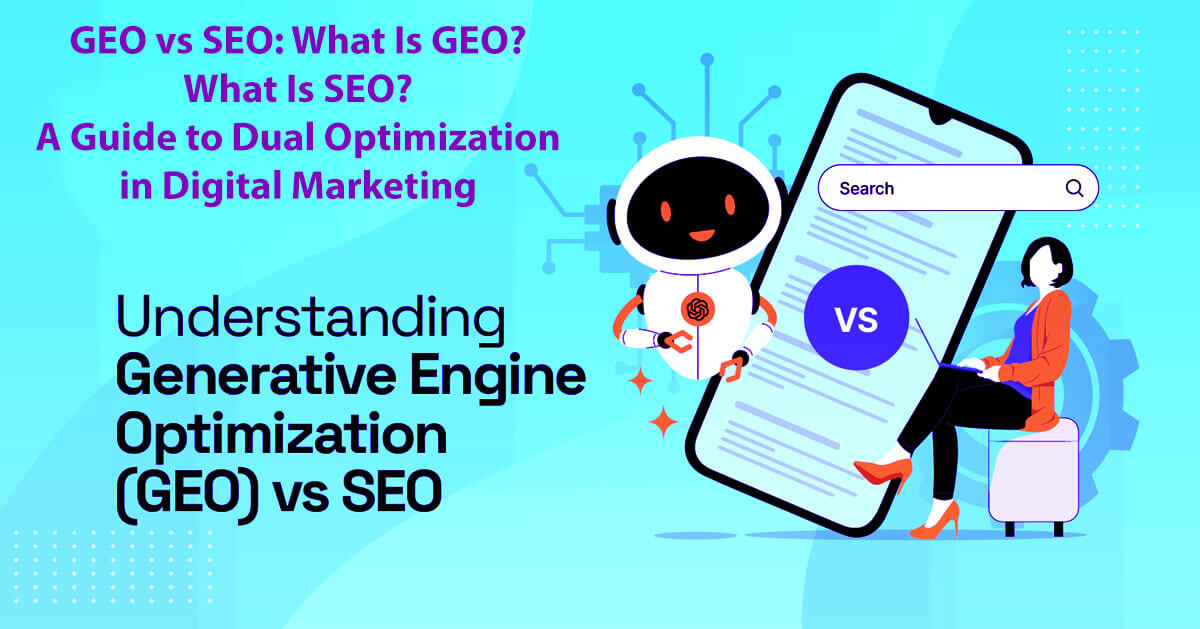





Let’s look at what makes GEO vs SEO: What is GEO? What is SEO? A Guide to Dual Optimization in Digital Marketing: Explore the differences and discover how to get the best results from each. This friendly guide will lead you through eight easy steps to help you excel in both areas of digital marketing.
You’ll learn important terms like GEO, SEO, and AI-powered search engines, and get practical tips for content, ranking, and working with others.
The goal is to help your digital presence stand out. Whether you want to improve local SEO or handle zero-click searches, these tips will help you move forward with confidence.
Search engine optimization (SEO) is undergoing major changes as a new approach, Generative Engine Optimization (GEO), gains popularity.
GEO is designed to improve content for AI-driven search engines like ChatGPT and Microsoft Copilot, which aim to give users a single, clear answer to their questions.
In contrast, traditional SEO continues to optimize content for established search engines like Google and Bing, which typically display multiple links in search results, enabling broader exploration of information across various sources.
There are important differences between how AI search engines and traditional search engines work.
Traditional search engines like Google usually show many links on each results page, often up to ten, so users need to visit different sites to find what they need.
In contrast, AI-powered platforms provide users with direct summaries that answer their questions, so they do not have to sort through many options.
This change makes searching easier and gives users quick access to the information they want.
When comparing GEO and traditional SEO, it is clear that each has its own priorities, shaped by its approach.
GEO focuses on making content conversational and relevant to the context. It uses structured data formats, such as schema markups, and provides direct answers supported by trusted sources.
On the other hand, SEO still relies on traditional methods, such as using keywords, building backlinks, and focusing on important on-page elements, such as meta tags and headlines, to improve search visibility.
One major result of the move toward GEO is that direct website traffic is expected to go down.
Because AI search engines can give full answers on their own, users might not feel the need to visit other websites for more details.
It is very different from traditional SEO, which aims to drive traffic to websites by achieving high search rankings and encouraging users to click through.
Because of these changes, businesses should consider using both GEO and SEO together.
By combining these strategies and using tools like OmniSEO®, organizations can boost their visibility on traditional search engines, AI-driven services, and social media.
As users switch between different search tools, it is important to cover both GEO and SEO when optimizing content.
GEO vs SEO: What Is GEO? What Is SEO? A Guide to Dual Optimization in Digital Marketing in 8 Easy Steps
In this topic:
GEO vs. SEO compares Geographic Optimization and Search Engine Optimization, highlighting how each approach works and where they are most useful.
Generative Engine Optimization uses techniques to boost visibility on platforms with generative AI, making content easier to find in AI-driven searches.
GEO Optimization means adjusting content and strategies to improve visibility and relevance in search results for certain geographic areas.
SEO Optimization is a broad approach to making websites more visible and higher-ranked in search results, using a range of techniques and best practices.
AI Search Engine Optimization involves creating strategies to help content perform better on AI-powered search engines by understanding how algorithms and user intent work.
Microsoft Copilot SEO uses Microsoft’s Copilot AI tool to enhance search strategies and create content to build a stronger online presence and drive greater engagement.
ChatGPT Search Optimization means shaping content to work better with AI chat platforms like ChatGPT, especially for conversational search queries.
Traditional SEO Strategies include well-known methods for improving websites, such as keyword research, building backlinks, and on-page SEO.
GEO Content Strategy is about creating content for local audiences, taking local details and preferences into account.
Search engine ranking indicates a website’s position in search results, influenced by various optimization techniques and algorithms.
Structured Data SEO involves adding structured data to websites so search engines can better understand the content, thereby improving visibility.
Schema Markup GEO uses schema markup to improve local search results and give search engines more useful information about geographic content.
Brand Mentions in AI Answers are important because being mentioned in AI-generated responses can boost a brand’s visibility and authority.
Citation Frequency AI looks at how often a brand or content is mentioned in AI-generated answers and how this affects search rankings and credibility.
AI-Driven Search Visibility means using strategies tailored for AI algorithms to improve online presence, with a focus on how AI changes search habits.
OmniSEO brings together different SEO strategies across many platforms and channels to create a unified approach to online optimization.
Keyword Research for SEO involves finding and analyzing the keywords potential customers use, which is key to effective SEO planning.
Keyword Integration GEO means adding geographic keywords to your content strategy to boost local search visibility and relevance.
Local SEO vs. GEO examines how local SEO, which targets local searches, differs from GEO, which focuses on broader geographic strategies, and where they overlap.
Zero-Click Searches are search results that give instant answers, so users do not need to click on a website. Understanding their impact is important.
AI-powered search engines use advanced AI technology to make searching easier and more accurate for everyone. They are designed to improve your experience by providing more precise, relevant search results, making it easier to find what you’re looking for.
Digital Marketing Optimization involves using multiple digital marketing strategies to boost online visibility and performance.
Dual Optimization Strategies involve using both SEO and GEO simultaneously to achieve the best visibility and reach.
SEO and GEO Collaboration shows how these two strategies can work together to make online marketing campaigns more effective.
Content for Generative Search is about creating content that works well in settings powered by generative search technologies.
Here are the main differences between GEO and traditional SEO:
Target Platforms: GEO is specifically designed for AI-driven search engines like Microsoft Copilot, while SEO primarily caters to traditional search engines such as Google and Bing.
Result Types: GEO gives users a single summarized answer to their questions, while SEO shows several pages of search results for users to browse.
Content Approach: GEO content should sound conversational and fit the context, while SEO depends more on keywords, backlinks, and metadata to help content get found.
Traffic and Formats: GEO often uses a variety of content types, such as PDFs, mind maps, and code snippets, in its answers. This means users do not need to click through many links.
In contrast, SEO usually focuses on text results, which encourage users to visit the top-ranking websites.
The rise of generative AI search engines, such as Microsoft Copilot, has changed how people use search results.
Instead of showing lists of links with short descriptions, AI search engines now give summarized, multi-format answers that respond to users directly and efficiently.
For this reason, it is now very important for businesses to optimize their web pages for AI-driven search engines.
Generative Engine Optimization (GEO) helps make sure that content is both visible and useful to advanced AI search platforms.
This guide looks at the main differences between GEO and traditional SEO. It will help you decide which approach works best for you, or if using both is the best option.
This guide will cover:
A detailed look at what GEO is and how it works.
An overview of traditional SEO practices and why they matter.
In-depth comparisons that explain the unique differences and uses of GEO and SEO.
Expected trends in both GEO and traditional SEO and beyond.
Answers to common questions about the details and effects of GEO and SEO strategies.
By learning about these topics, businesses can better handle the changing world of search.
What is GEO?
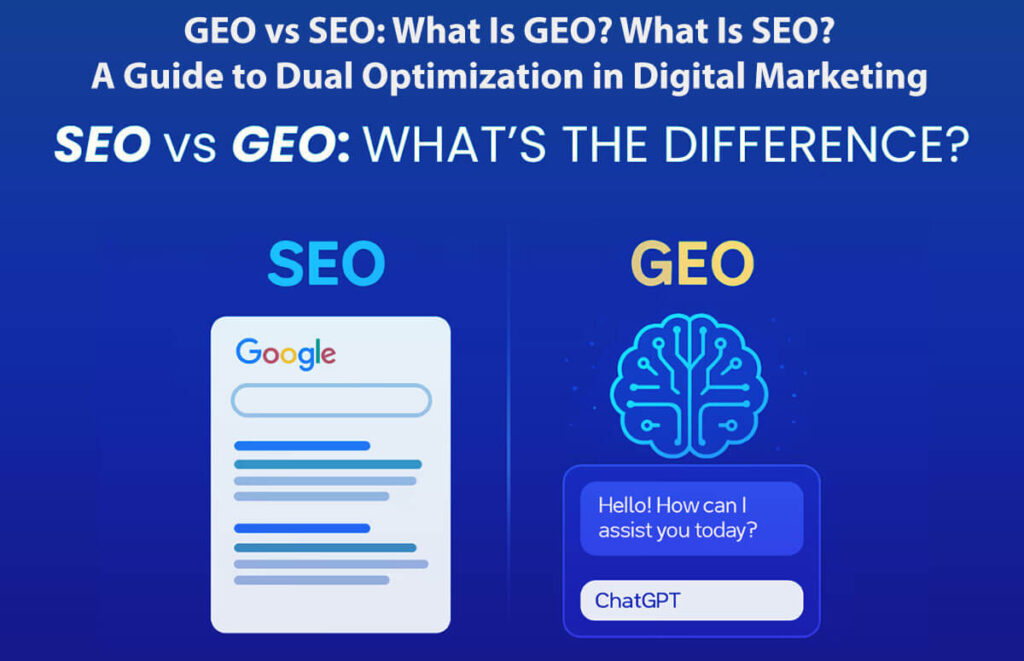
Generative Engine Optimization (GEO) is a method created to help content stand out and work better on new generative AI search engines.
Platforms like ChatGPT, Perplexity AI, and Microsoft Copilot use advanced technology to share information in a more conversational and context-aware way.
GEO is based on Search Engine Optimization (SEO), which focuses on making content more visible in regular search engines like Google and DuckDuckGo.
As AI changes how we search for information, content creators need to update their strategies to stay relevant.
GEO is about preparing content for how large language models (LLMs) interact with users through AI search engines, chatbots, and built-in search tools.
This approach focuses on ensuring content is clear and accurate so users quickly get the answers they need.
What is SEO?
Search Engine Optimization (SEO) enhances your website’s visibility and attractiveness. It improves your site’s search engine ranking, helping more people discover your offerings more easily.
This strategy means understanding how each search engine works, so your website can be found, organized, and listed correctly.
Good SEO depends on knowing how search engines work, what users want, and how they behave online.
When a website matches what search engines look for, it can move up in search rankings.
Usually leads to more visitors and can help increase sales or sign-ups.
Key Differences Between SEO and GEO
Comparison of SEO vs GEO
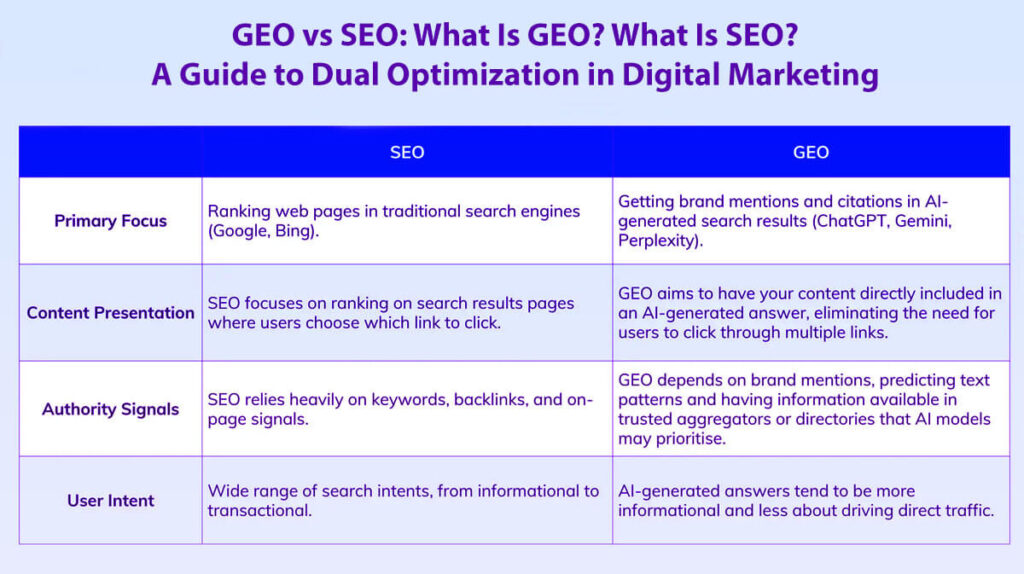
Both GEO and SEO aim to help brands get noticed online, but they differ in important ways, such as the platforms they target, the results they deliver, their content strategies, and how they engage users.
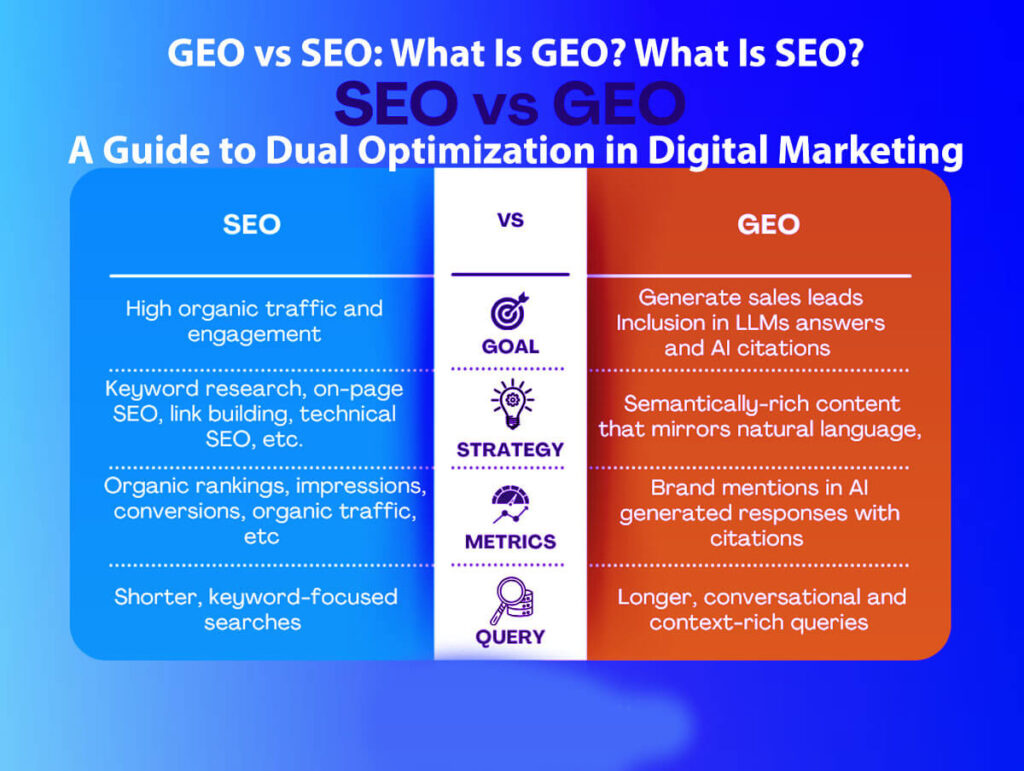
The table below shows the main differences between GEO and SEO.
Feature GEO SEO
Target Platforms: primarily focus on AI-driven search engines such as Microsoft Copilot and on generative AI outputs. Concentrates on traditional search engines like Google, Bing, and Yahoo.
Type of Results: Provides users with a single, concise answer synthesized from various sources. Displays multiple search results pages, offering several options for user exploration.
Content Focus: Requires content to be conversational, contextually relevant, and indexable by AI models. Depends on keyword optimization, link-building strategies, and established SEO best practices.
Content Formats: Accommodates diverse formats, including PDFs, mind maps, code snippets, and more, based on user queries. Primarily emphasizes text-based results, gradually incorporating multimedia elements such as videos and images.
Ranking Factors: evaluates content based on quality, structure, and contextual relevance for effective indexing and ranking. Utilizes keywords, backlinks, and metadata as primary drivers for search result rankings.
Traffic Generation: Supplies provides users with a comprehensive, all-in-one solution on a single page, reducing the need for multiple clicks. Lists the top search results as clickable links, encouraging user engagement through exploration of various sources.
Target Platforms
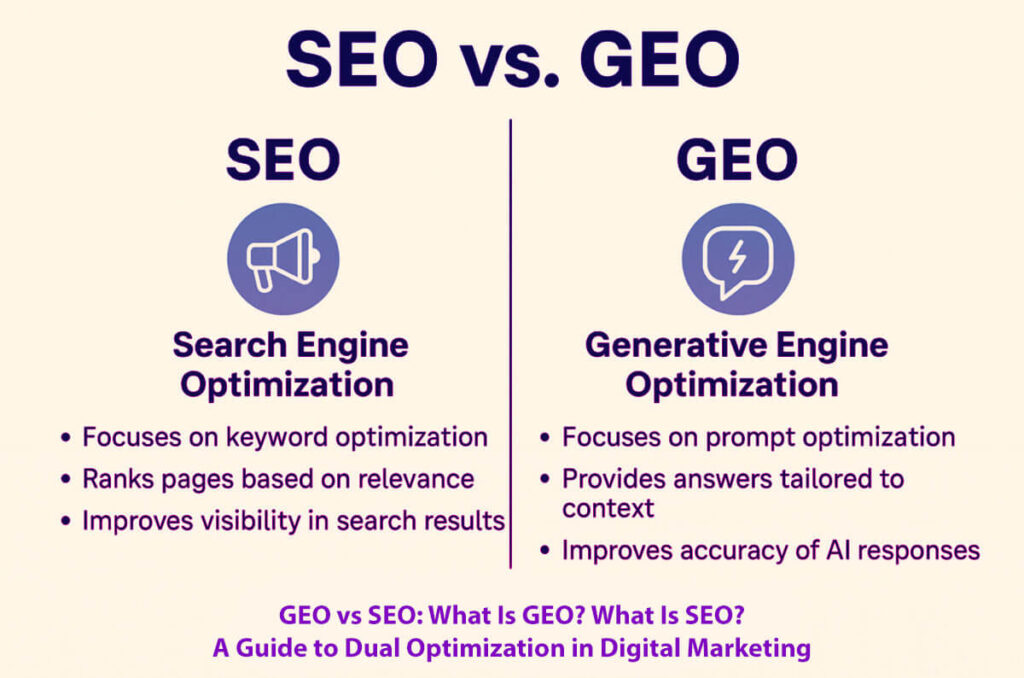
GEO is all about improving content for generative AI search engines like ChatGPT and DeepStake.
These platforms use AI to deliver clear, helpful summaries to users.
On the other hand, SEO helps make websites more interesting and useful to people using regular search engines.
Means planning and improving content so it appears higher in regular search results.
Type of Results
One big difference between AI-driven and traditional search engines is how they shape the user experience.
Traditional search engines like Google usually show about ten results on the first page.
Let users pick from different links based on what they think will help them most.
AI search engines like Perplexity change this by pulling together information from many sources, such as blogs, videos, images, and social media.
Instead of showing many links, AI search engines provide a single, complete answer, making it easier to find information.
For example, if you search for chocolate cake recipes, an AI search engine will give you a summary with the key information, so you do not have to click through a list of links.
This new approach helps users get complete answers quickly and easily.
Context Focus
Search Engine Optimization (SEO) focuses on selecting the right keywords and ensuring the information matches what users are searching for.
Marketers develop SEO content by incorporating keywords naturally and seamlessly.
This approach improves readability and boosts its ranking in search engine results pages (SERPs).
For example, if someone searches for help with a garage door that won’t open, good SEO content will include phrases like “garage door not opening” to match what users type.
Generative Engine Optimization (GEO), on the other hand, focuses more on understanding what users want and the context of their questions, rather than just placing keywords.
Instead of just using keywords, GEO pays attention to how users phrase their questions, like:
“How do I fix a stuck garage door?”
This approach helps organize content so that AI tools can better understand what users mean, making interactions with search engines feel more like a conversation.
Content Formats
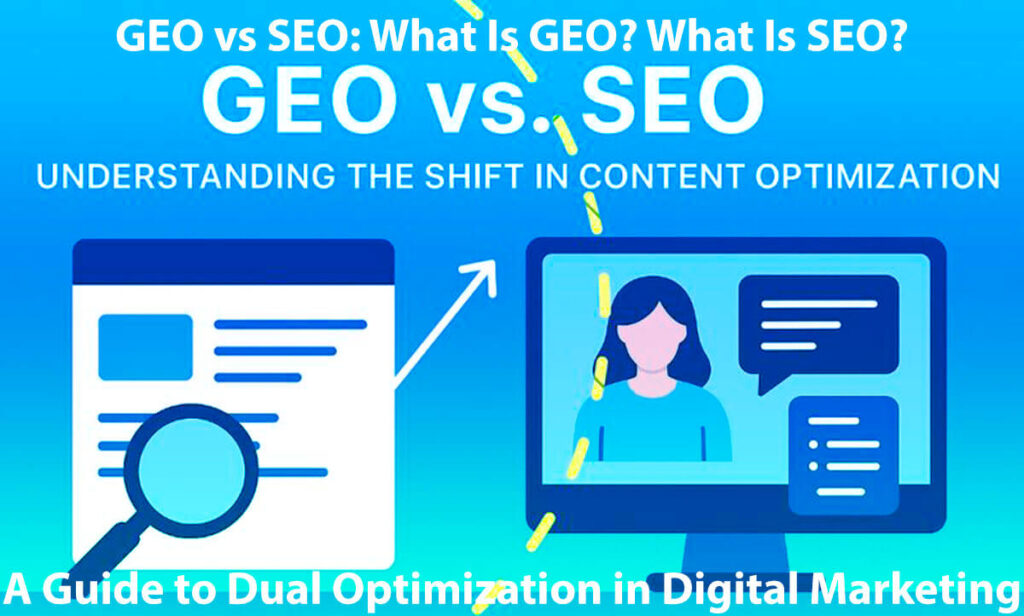
SEO usually aims to deliver the most helpful and informative static results, while GEO considers the bigger picture.
GEO aims to show users content that fits their situation, taking into account their behavior, age group, and personal preferences.
As search engines have evolved, content is no longer just text. Now, users see many different types of formats.
These formats include AI-generated summaries, social media posts, videos, interactive sessions, and product listings, all designed to improve the user experience.
For example, if someone searches for the iPhone 17, an AI-generated summary would be tailored to their input and situation.
Advanced AI search engines use different prompts to adjust content formats based on the user’s query.
Depending on what the user asks, search results might be short code examples, mind maps, tables, or step-by-step guides, matching different needs and preferences.
Indexing and Ranking Factors
Indexing and ranking factors are the rules that content and websites need to follow to appear at the top of search results.
SEO and GEO share some basic ideas, but they differ significantly in how they are put into practice.
To build a strong SEO strategy, keep these steps in mind:
Do thorough keyword research: Find the most relevant and popular search terms in your field.
Add internal and external links: Build credibility by linking to trusted sources and other useful pages on your own site.
Incorporate meta tags, headings, and subheadings to systematically organize your content and facilitate enhanced comprehension by search engines.
Produce high-quality, relevant content that informs and addresses users’ needs and interests.
Optimize user experience: Optimize page load speeds and enhance mobile compatibility for a seamless browsing experience.
These steps are important for SEO, but there are extra strategies that can help you rank well in AI-powered search engines using GEO:
Make engaging, well-organized content: Write in a way that connects with readers and encourages them to keep exploring.
Be clear when answering user questions: Address their needs directly to make your content more relevant and satisfying.
Use structured data formats: Add schema markup so search engines can better understand your content.
Cite reputable sources: Back up your facts and statistics with trustworthy links to make your content more reliable.
Traffic and Metrics
One challenge for website owners with GEO is that it can reduce overall website traffic.
Happens because AI search engines often give users complete summaries, so people may not feel the need to visit other websites.
In contrast, traditional SEO helps well-optimized pages show up higher in search results, which usually leads to more clicks and site visits.
It’s also easier to measure how well SEO is working compared to tracking the results of GEO strategies.
You can easily track your SEO performance by checking key metrics like click-through rates, conversion rates, and bounce rates. These provide a clear view of how well your content is performing.
With GEO, success is measured by impression metrics, such as how visible your citations are, how accurate and reliable your information is, and how well your content matches user questions.
Because of this change, businesses need to adopt new methods to measure user engagement and assess the effectiveness of their content.
GEO and SEO Trends: A Comprehensive Overview
Generative Engine Optimization (GEO) and Search Engine Optimization (SEO) are evolving rapidly, and each is shaping the other in significant ways.
Businesses, marketers, and content creators must stay current with these trends to maintain visibility in search results and AI-driven queries as they evolve.
This overview examines the major trends shaping the digital landscape.
The Evolution of SEO: A New Era, Not the End
New technologies have led some to question what will happen to SEO.
However, SEO is not becoming obsolete. Instead, it is going through major changes.
Traditional SEO primarily focused on optimizing content to improve search engine rankings and drive user clicks to websites.
GEO, on the other hand, focuses on making content a reliable source that AI systems can easily find and use to share information.
Marks a big change, as content can now be seen as valuable even if users do not visit the website.
If you see GEO as just an add-on to SEO, like adding a few FAQs or new techniques, you risk falling behind in today’s fast-changing digital world.
This change is real and offers a practical guide for keeping up with the changing world of search.
Clarifying the Concepts: Important Definitions
SEO (Search Engine Optimization): Optimizing web pages to improve search engine rankings enhances visibility, attracting more clicks and visits from users seeking relevant information.
GEO (Generative Engine Optimization): GEO is about creating and shaping content so that generative AI systems can easily extract, summarize, and credit insights.
This approach helps your content get noticed even before people visit your website, making it a trusted source for both users and AI.
Shifting the Focus: From “Ranking” to “Answer Selection”
One of the biggest changes is how we now approach these optimization strategies.
Traditional SEO sought to answer the question:
“How do I become the best result?”
GEO, however, adopts a different perspective, asking:
“How do I provide the best explanation?”
This change means it is no longer just about being at the top of search results. Now, it is about being the clearest and most trusted source among all the information out there.
Foundational Principles Remain Intact
If you already know modern SEO, you do not need to forget what you have learned.
GEO builds on the basics of SEO and makes them even more important today:
Establishing Clear Topical Authority: Position yourself as an expert by consistently delivering high-quality, focused content in your niche.
Maintaining a Strong Internal Linking Structure and Logical Site Architecture: Facilitate better navigation for both users and search engines by using a well-organized site layout with relevant links.
Creating Expert-Led Content with Transparent Authorship Credentials: Highlight the qualifications of your content creators to enhance credibility and trustworthiness.
Providing Original Examples, Frameworks, or Unique Data: Differentiate your content by presenting fresh insights or analysis that cannot be found elsewhere.
Structuring Content in an Engaging and User-Friendly Manner: Use clear formatting, bullet points, and intuitive layouts to enhance user experience.
Ensuring Speed, Trust, and Sound Technical Optimization: Page load times, mobile responsiveness, and reliable hosting are crucial for maintaining user engagement and trust.
In the end, GEO does not replace traditional SEO. Instead, it helps websites with strong SEO become even more visible and engaging.
Main Changes: Five Critical Adjustments
1. Focusing on “Answer Selection” Over Clicks:
With traditional SEO, success was often measured by how many clicks you got.
But in generative search, success is often about how many times your content is mentioned or cited.
This change means your information needs to be easy to find and seen as trustworthy, so AI systems are more likely to reference it.
2. Leveraging Structure as a Competitive Advantage:
Generative AI works best with content that is broken into clear, easy-to-read sections.
Effective strategies can include:
Use succinct and focused topic sentences.
Implementing concise subheadings to guide readers.
Creating distinct sections for “what it is,” “why it matters,” and “how to do it,” ensuring clarity and comprehension.
Designing checklists or outlines that provide quick, actionable insights.
Long, confusing introductions and unclear statements now hurt your rankings and make it harder for AI to summarize your content.
3. Prioritizing “Brand Clarity” Over Keyword Density:
With generative AI, it is more important than ever to keep your brand message clear and consistent.
AI pulls information from many sources and prefers brands that demonstrate clear, focused expertise.
Enhance brand recognition by reiterating your unique perspective across diverse content formats, including:
Comprehensive guides that educate your audience.
Original research or experimental findings that add to industry knowledge.
In-depth case studies and analytical breakdowns that illuminate your expertise.
Glossaries and explanatory articles that provide value to users seeking understanding.
If your content lacks a unique voice or point of view, it may be seen as generic and get lost among competitors in today’s AI-driven market.
4. Providing Evidence of Value:
AI values clear content, but it also looks for information that is credible and well-supported.
To make your content a trusted source, add real evidence throughout your writing, such as:
Brief case studies showcasing practical applications of your insights.
Specific statistics or figures that lend weight to your claims.
Documented outcomes displaying changes before and after implementing specific strategies.
Tools utilized for experimentation that demonstrate engagement with current methodologies.
Insights into trials that did not yield expected results, showcasing a transparent and credible narrative.
When you include this kind of evidence, your content becomes a reliable source for AI to summarize, which boosts its credibility and trust online.
To succeed in today’s complex information world, it is important to understand how GEO and SEO work together.
By using these new strategies, individuals, businesses, and organizations can make their content stand out from the competition.
Learning and adapting to these changes is the key to long-term success in digital visibility.
5. Visibility Without Clicks Becomes the New Normal
As digital content keeps changing, your work might reach more people through AI-generated answers, but this often means fewer visits to your website, especially for basic informational searches.
This shift is not a setback. Instead, it’s a reminder for content creators and marketers to update their strategies.
The aim is to make content that does two things well: earns citations to boost brand awareness and ranks in search results to attract visitors who are ready to take action.
The “Twin-Lane” Model: An Efficient Strategy for GEO That Maintains SEO Effectiveness
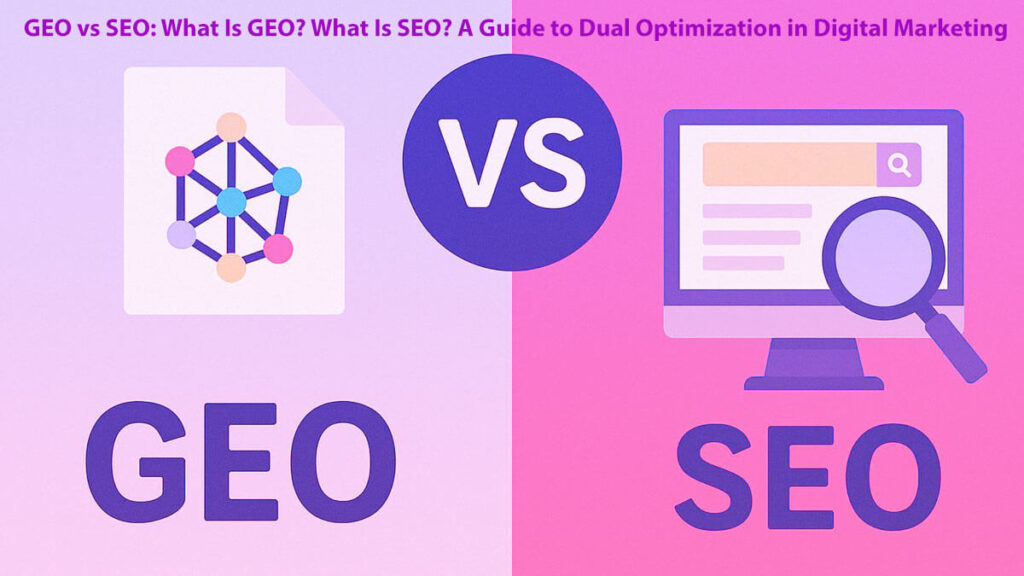
Many teams make the mistake of treating Geo-Optimized strategies (GEO) like just another platform upgrade.
Usually leads to confusion and mixed results. Rather than switching everything over, try a clear, practical two-part approach I call the Twin-Lane Content Engine.
Lane A: SEO Pages for Demand Capture
This lane aims to develop web pages that rank highly in search results, transform visitors into customers, and drive revenue growth.
Types of content for this lane include:
Best-of Lists: Collections that showcase the top products or services in a niche, helping people choose wisely.
Comparison Pages: Pages that compare similar options side by side, making it easy to see the main differences and similarities.
Category pages: Overviews that organize products by category, making it easier for users to explore their options.
High-Intent How-To Guides: Step-by-step guides made for users who know what they want, helping them find exactly what they need.
Product and Solution Pages: Detailed pages that explain the benefits, features, and uses of your offerings to help buyers make decisions.
Every page in Lane A should aim to rank well and focus on turning visitors into customers.
Lane B: GEO Assets for Citation Leadership
Lane B, on the other hand, is about creating content that becomes the go-to resource for AI-generated answers.
For this lane, focus on content like:
Definitive “What is X?” Explainers: Clear definitions that explain key terms in your field, giving readers quick and reliable information.
Industry Glossaries: Lists of important terms in your field, making it easy for readers to look up and understand complex ideas.
Original Research and Benchmarks: Unique studies that share useful insights, data, and trends, helping your brand stand out as a leader.
Opinionated Frameworks with Real Examples: Clear frameworks with real examples so that readers can understand concepts through practical situations.
The main goal in this lane is to make sure that when AI answers questions, it uses your content as the most reliable and complete source.
The 7-Point AI Citability Checklist
To make your informational pages work better for GEO, use this checklist to help your content get cited by AI systems:
Define the Term Early: Explain the main term in the first 100-150 words so readers know right away what you mean.
Include a Short “Why It Matters” Section: Briefly explain why the term or concept is important to keep readers interested.
Introduce a Simple Framework: Use a clear structure with 3 to 5 parts to make the information easy to follow.
Provide Concrete Examples for Each Part: Give real, relatable examples for each section to make your points clear.
List Trade-offs: Talk about the pros and cons, showing when the idea works well and when it might not.
Show Authorship and Credibility: Name the author and share their qualifications to build trust.
Keep Facts Up-to-Date and Avoid Empty Statements: Make sure your content is current and meaningful, not outdated or vague.
This checklist is effective not because of any “AI tricks,” but because it shows strong writing and clear expertise.
A Quick Example: What an AI-Ready Paragraph Looks Like
A lot of content doesn’t do well in GEO because it’s too vague and lacks real value. For example:
Weak Statement: “Marketers should focus on quality content and strategy in the AI era.”
Strong Statement: “Generative Engine Optimization (GEO) is a forward-thinking strategy that enhances a brand’s visibility in AI-generated answers by structuring content into precise definitions, actionable steps, and evidence-backed frameworks.
Essentially, GEO underscores the importance of authoritative authorship, concise yet thorough explanations, and practical examples—empowering your brand to emerge as the preferred source that AI summarizes rather than merely a link it overlooks.”
Both sentences talk about the same topic, but the second one is built for AI to use, while the first is just filler without much detail.
What to Measure in a GEO-Focused World
If you only track traditional website visits, you might miss important wins in today’s changing digital world.
To get a fuller picture of your results, try using a simple GEO scoreboard to track key metrics like:
Brand Mentions in AI Answers: Monitor how frequently your brand is referenced within AI-generated content.
Citation Frequency for Category Terms: Assess how often your specific terminology is cited, indicating your content’s authority.
Share of Voice for Definitional Queries: Evaluate your presence in discussions surrounding key terms and concepts in your industry.
Branded Search Growth: Analyze increases in searches for your brand name, reflecting growing awareness and interest.
Newsletter/Owned Audience Conversion Rate: Measure the effectiveness of your content in converting your audience into loyal customers or leads.
Remember this key rule: GEO is about building brand awareness, while SEO is mainly about capturing user intent.
Using a strong strategy for both GEO and SEO can help your brand grow steadily and become more visible online.
The Uncomfortable Truth and the Opportunities Ahead
As the digital world changes quickly, it’s important to understand that Geographic Engagement Optimization (GEO) does not replace Search Engine Optimization (SEO). Instead, GEO works alongside SEO.
GEO has become important because so much online content is generic and uninspired. Makes it hard for brands to truly connect with their audiences.
To succeed in this new environment, brands need strategies that may seem challenging to marketers accustomed to older methods.
These strategies include:
1. Publishing Well-Informed Opinions
To truly engage your audience, share insights that are backed by solid research and real evidence.
Well-informed opinions help engage your audience and boost your brand’s credibility. When you share informed ideas, you build trust and encourage people to explore more of your content.
2. Documenting Testing Experiences
Sharing stories about both your successes and failures makes your brand feel more authentic and relatable.
When you talk about your testing experiences, you connect better with customers and show the real people behind your brand.
Being open in this way can make complex topics easier to understand and help build a sense of community with your audience.
3. Developing Named Frameworks
When you create unique frameworks and give them names, it becomes easier for your audience to connect with your ideas.
Assists in positioning your brand as a leader within your industry while fostering a warmer and more sincere connection with your clients.
Giving your methods clear names also makes it easier for others to talk about and explore your ideas in professional settings.
4. Substantiating Claims with Concrete Examples
In a crowded market, using vague words and generic claims can hurt your credibility. Instead, share clear and specific evidence to back up what you say.
Real-world examples, case studies, and strong testimonials can serve as proof and make your message more convincing.
With artificial intelligence becoming more common, the best way to set your brand apart is to avoid the usual writing styles that sound like everyone else.
Being original and authentic will help your brand the most.
The Bottom Line
The new standard for creating digital content is actually quite simple:
Aim to rank when users are ready to click: Focus on answering their questions so your content shows up when it matters most.
Work to get cited when users look for answers: Make your brand a trusted source that people feel good about turning to for information.
GEO is more than just a trend. It’s the next step in SEO, focusing on clear, authoritative, and well-structured content that is useful and connects with people.
This approach helps your brand succeed on different search platforms and reduces the risk of depending too much on just one, which could change unexpectedly.
1. Elevating Expertise as a Valuable Asset
To do well in both GEO and SEO, it’s important to highlight your expertise. As search engines, both traditional and AI-driven, continue to evolve, they are increasingly focused on providing reliable, trustworthy information.
Demonstrating your professional qualifications will become increasingly important in the future.
Here are effective ways to establish and promote your expertise:
Improve your author profiles by clearly listing your credentials, awards, and major achievements to build a strong professional image.
A well-written author bio can make a big difference in how your audience sees your authority.
Share case studies that show your skills by highlighting your successes and the challenges you’ve overcome in your industry.
Shows what you can do and helps potential clients imagine their own success with your help.
Create original content that offers insights and perspectives people can’t find anywhere else.
Being original helps you become an authority and attracts loyal followers.
Share your expert knowledge through articles, workshops, or talks to show your leadership in your field.
Doing this builds your reputation and helps you connect with your community.
When you show your expertise, you improve your website’s E-E-A-T (Experience, Expertise, Authoritativeness, and Trustworthiness) and increase your chances of ranking well in both traditional and new AI-driven search platforms.
2. The Rise of Zero-Click Searches
Looking forward, zero-click searches are likely to become even more common on traditional search engines.
Zero-click searches happen when users get the information they need right in the search results, so they don’t have to click through to a website.
AI technology has significantly contributed to increasing the popularity of this trend.
Features like AI Overviews give quick, clear summaries at the top of search results, answering users’ questions so they can move on without clicking further.
Because of this, you might see the same number of impressions but fewer actual clicks, creating new challenges for brands that want to drive people to their websites.
3. A Diverse Search Journey
Online search has changed a lot since AI search began, moving away from the simple paths people used before.
This search journey is expected to become even more complex and varied in the future.
People might start their research on AI platforms like ChatGPT, then switch to traditional search engines like Google, or move back and forth between different options to find all the information they need.
With search behavior becoming more varied, it’s important to use GEO and SEO together.
Using both strategies helps you reach potential customers no matter which platform they use to search for information.
By taking this approach, you set your brand up to succeed as the digital landscape continues to evolve.
Can GEO and SEO Collaborate?
Yes, combining GEO (Generative Engine Optimization) and SEO (Search Engine Optimization) is not just helpful; it’s essential. It is essential for boosting your search visibility across many different platforms.
Means reaching people through traditional search engines like Google, social media, and new AI-powered search engines that are changing how we find and use information.
A strong GEO and SEO strategy helps you make your content and website more appealing to both users and search engines.
Here are some important strategies to help you successfully combine GEO and SEO:
Keyword Integration: It’s important to include relevant keywords throughout your content naturally.
Placing keywords thoughtfully helps your content show up in search results, making it easier for people to find your website.
Do thorough keyword research to find terms your audience is searching for, and use them in your headlines, subheadings, and main content.
High-Quality Content: Create content that is informative, well-organized, and interesting to read.
Ensure your content is clear and comprehensible to all audiences, including visitors and artificial intelligence systems. When your message adopts the appropriate tone, it enhances visitors’ comfort and improves your website’s ranking in search engine results.
Support your content with good research, make your value clear, and answer your audience’s questions directly.
Build Authority: It’s important to show your expertise on different digital platforms for both GEO and SEO.
You can do this by getting reviews, joining social media conversations, and taking part in industry forums to boost your online presence and credibility.
A good reputation builds trust, which is important for both users and search engines when judging your content’s quality and relevance.
Structured Data: Adding FAQs, how-to guides, and detailed product info can really boost your visibility.
Makes it easier for both AI and regular search engines to index your content properly.
Using schema markup helps search engines index your site and can get your website featured in rich snippets, bringing in more visitors.
OmniSEO®: An Effective Tool to Boost Business Growth
OmniSEO® is a unique tool from WebFX that helps businesses improve their search rankings on all platforms.
With this tool, you can reach more people from different sources and grow your revenue faster.
By using OmniSEO®, you can make the most of your marketing resources and get better results by combining GEO and SEO strategies.
Frequently Asked Questions about GEO vs SEO
Here are answers to some common questions about the differences between GEO and SEO:
Is GEO Replacing SEO?
No, some people think GEO will replace SEO, but that’s not true. GEO actually builds on the strong foundation SEO has created over time.
GEO works with SEO to ensure your business shows up not just on traditional search engines, but also on new AI-powered platforms.
How Does GEO Differ from SEO?
GEO focuses on making your website and content more visible in AI-driven search engines like Microsoft Copilot.
SEO, on the other hand, is about improving your visibility on traditional search engines like Google.
By using both, businesses can reach more people as search behavior changes.
How Do You Optimize for GEO?
To optimize your website for GEO, create high-quality, well-organized content that clearly answers users’ questions.
Adding schema markup and structured data helps search engines better interpret and index your website, boosting your content’s visibility.
Because this approach is specialized, many businesses choose to hire professional GEO services to ensure everything is done correctly.
GEO vs. SEO: Frequently Asked Questions (FAQ)
Q1: What is GEO?
A1: GEO stands for Geographical Optimization. It means making your content and online presence work better for certain locations. Helps businesses reach people in specific areas, which is great for local marketing.
Q2: What is SEO?
A2: SEO stands for Search Engine Optimization. It means making your website show up higher in search results. It can involve using the right keywords, creating helpful content, and improving your website’s technical setup to get more visitors.
Q3: How do GEO and SEO differ?
A3: SEO is a broad approach to improving your website’s visibility in search results. GEO, on the other hand, focuses on local searches. GEO uses keywords related to locations and aims to reach people nearby, while regular SEO might target anyone, no matter where they are.
Q4: Why is GEO important for local businesses?
A4: GEO is important for local businesses because it helps them connect with people nearby. By focusing on local searches, businesses can get more customers in their area, bring more people into their stores, and become better known in their community.
Q5: Can GEO be part of a larger SEO strategy?
A5: Yes! GEO can be a key part of your overall SEO plan. If your business wants to reach people in certain areas, using GEO along with regular SEO helps you find and connect with local customers.
Q6: What tools can help with GEO optimization?
A6: Tools like Google My Business, Moz Local, and BrightLocal assist with GEO optimization. They allow you to manage your local listings, monitor reviews, and evaluate your local SEO performance.
Q7: How can I tell if my GEO efforts are working?
A7: You can check if your GEO efforts are working by looking at your local search rankings, seeing how much website traffic comes from local searches, and tracking things like calls or visits from people in your area.
If you have more questions, ask!
GEO vs. SEO compares Geographic Optimization and Search Engine Optimization, highlighting how each approach works and where they are most useful.
Generative Engine Optimization uses techniques to boost visibility on platforms with generative AI, making content easier to find in AI-driven searches.
GEO Optimization means adjusting content and strategies to improve visibility and relevance in search results for certain geographic areas.
SEO Optimization is a broad approach to making websites more visible and higher-ranked in search results, using a range of techniques and best practices.
AI Search Engine Optimization involves creating strategies to help content perform better on AI-powered search engines by understanding how algorithms and user intent work.
Microsoft Copilot SEO uses Microsoft’s Copilot AI tool to enhance search strategies and create content to build a stronger online presence and drive greater engagement.
ChatGPT Search Optimization means shaping content to work better with AI chat platforms like ChatGPT, especially for conversational search queries.
Traditional SEO Strategies include well-known methods for improving websites, such as keyword research, building backlinks, and on-page SEO.
GEO Content Strategy is about creating content for local audiences, taking local details and preferences into account.
Search Engine Ranking indicates a website’s position in search results, determined by various optimization techniques and algorithms.
Structured Data SEO involves adding structured data to websites so search engines can better understand the content, thereby improving visibility.
Schema Markup GEO uses schema markup to improve local search results and give search engines more useful information about geographic content.
Brand Mentions in AI Answers are important because being mentioned in AI-generated responses can boost a brand’s visibility and authority.
Citation Frequency AI looks at how often a brand or content is mentioned in AI-generated answers and how this affects search rankings and credibility.
AI-Driven Search Visibility means using strategies tailored for AI algorithms to improve online presence, with a focus on how AI changes search habits.
OmniSEO brings together different SEO strategies across many platforms and channels to create a unified approach to online optimization.
Keyword Research for SEO involves finding and analyzing the keywords potential customers use, which is key to effective SEO planning.
Keyword Integration GEO means adding geographic keywords to your content strategy to boost local search visibility and relevance.
Local SEO vs. GEO examines how local SEO, which targets local searches, differs from GEO, which focuses on broader geographic strategies, and where they overlap.
Zero-Click Searches are search results that give instant answers, so users do not need to click on a website. Understanding their impact is important.
AI-powered search engines use machine learning to improve your search experience and deliver more accurate results, making it easier to find what you need.
Digital Marketing Optimization involves using multiple digital marketing strategies to boost online visibility and performance.
Dual Optimization Strategies involve using both SEO and GEO simultaneously to achieve the best visibility and reach.
SEO and GEO Collaboration shows how these two strategies can work together to make online marketing campaigns more effective.
Content for Generative Search is about creating content that works well in settings powered by generative search technologies.
Boost Your Visibility and Achieve Results with OmniSEO®
Rather than creating separate SEO and GEO strategies, combine your efforts into a single, comprehensive plan.
OmniSEO® is a great way to help your website rank well across platforms like Google, OpenAI, Microsoft Copilot, Perplexity AI, Gemini, and Google AI Overviews.
By combining traditional SEO methods with new GEO tactics, OmniSEO® helps your business stay visible wherever people are searching.
This advanced tool lets you check your visibility, find gaps in your strategy, and discover valuable sources and citations to strengthen your online presence.
If you want to see what OmniSEO® can do, schedule a free demo today.
Services start at $50,000 per year. Contact us to learn more about our AI SEO options tailored to your business.
The Ranking Factor Nobody Discusses: Hard Work in 8 Easy Steps: A Guide
How to Remove Google Reviews: How to Delete Google Reviews in 8 Easy Steps—A Guide
How to Run a Giveaway or Contest That Actually Goes Viral in 8 Easy Steps