




The top 7 Best Bare Metal Hosting Services in 2026 include cheap servers, cloud providers, GPU servers, free options, and pricing details. These services cover bare metal and cloud hosting, highlighting leading companies in the sector.
I may receive commissions from links on this page because This Online Web is reader-supported. However, my editorial judgments and opinions remain unaffected by this.
If your workloads require predictable, low-latency performance and full control, such as in high-frequency trading, real-time analytics, or AI training, bare-metal hosting is a must.
When you rent a physical server without a hypervisor or shared resources, you get complete control over the operating system and software stack.
You can make kernel-level changes, apply NUMA pinning, and configure custom storage layouts.
This kind of control delivers consistent performance and reliable resource allocation, which is crucial for latency-sensitive tasks or those requiring strict compliance.
Selecting the right provider is crucial, as dedicated and bare-metal setups often involve higher upfront costs and increased management responsibilities.
Be sure to weigh these factors against the benefits, especially for AI, real-time analytics, and workloads that require compliance.
Below is an overview of the leading bare-metal hosting services, beginning with Atlantic.Net, an excellent choice for those who prioritize compliance and hands-on support.
Other providers address a range of use cases, operating systems, and budgets, including hourly bare metal cloud solutions and cost-effective European root servers.
A 10-Minute Test To Assess Bare Metal Suitability (No Guesswork)
This rapid self-assessment helps you avoid two common mistakes:
(1) paying for bare metal when a well-chosen virtual machine or dedicated plan would suffice, and
(2) staying virtual when issues like isolation, jitter, or tail latency are already adversely affecting your production environment.
Evaluation Questions and Their Importance:
Are p95/p99 latencies more critical to you than average latency?
Shared contention and scheduling variance first become apparent at tail latency scores of 0, 1, or 2.
Have you experienced production issues that appear to be jitter (spikes) rather than consistent slowness?
Jitter is a common indicator of erratic conflicts and “neighbor” impacts.
Does your compliance or security posture necessitate hardware-level isolation?
Single-tenant hardware often simplifies audit processes and enhances security, providing peace of mind for sensitive workloads.
Do you require OS/kernel control (huge pages, IRQ tuning, tuned kernels, custom modules, etc.)?
When the hardware topology is stable, deep tuning can be accomplished more consistently.
Do your workloads (e.g., inference-heavy services, game backends, ad tech, real-time analytics) rely on CPU cache?
In some cases, cache behavior and regular scheduling may be more important than pure core count.
Are you currently paying for “special VM types” such as isolated instances or dedicated cores?
If so, bare metal may be easier and, in some cases, more cost-effective.
Do you have high, steady storage I/O needs, such as for logs, databases, OLAP/ETL, or machine learning pipelines?
Predictable I/O pathways make it easier to control p95/p99 performance.
Do you need specific hardware configurations (e.g., local NVMe, custom RAID/ZFS, CPU model limits, or NUMA pinning)?
In this case, bare-metal becomes a necessity rather than a choice.
Can your team manage incident responses, backups, monitoring, and patching?
Managed options can reduce operational burdens; bare-metal environments reward operational maturity.
Is this a long-term need (as opposed to merely temporary burst capacity)?
Bare metal is most effective when you prioritize consistency over rapid turnaround.
How To Assess Your Score:
Further details on the evaluation will be provided here:
Understanding When Bare Metal is Necessary for IT Professionals
For IT professionals and system administrators, recognizing when bare-metal is not needed helps focus on architecture, caching, query patterns, and virtual machine (VM) selection to improve efficiency.
When to Consider Bare Metal
Use bare metal if you need deep tuning, strong isolation, or to deal with tail latency and jitter.
It works best for workloads that require high performance and customization, where these benefits outweigh the trade-offs in stability and control.
To support this decision, optimize for performance percentiles (e.g., p95 and p99) rather than averages, since users are most affected by tail latency.
For further insight, refer to Google’s SRE Book on latency distributions in production systems.
A Reality Check On Bare Metal: Understanding Your Benefits And Responsibilities
Bare metal offers full control over the operating system and kernel, predictable I/O, consistent CPU topology, reliable performance, and strong isolation.
However, you are responsible for patch management, backup and restore, advanced monitoring, and resolving hardware failures such as broken SSDs, faulty NICs, or RAM faults.
When assistance is required, consider managed bare-metal services or providers that offer prompt and efficient remote or on-site support.
Effective Methods For Tuning To Enhance P99 Performance
Focus on kernel-level adjustments, NUMA pinning, and specialized storage setups after establishing the basics. The following areas often enhance low-latency performance:
IRQ Affinity and Interrupt Handling: The location of interrupts can significantly affect consistency on low-latency systems. A summary can be found at Red Hat’s Performance Tuning Guide.
Linux Networking Scaling Primitives: On multi-core systems, Receive Side Scaling (RSS), Receive Packet Steering (RPS), Receive Flow Steering (RFS), and Transmit Packet Steering (XPS) play important roles; packet steering decisions can lead to tail latency. More information is available at Linux Kernel Networking.
Percentiles vs. Averages: It is important to optimize for performance metrics that reflect user experience, especially if p95/p99 metrics are not closely monitored. Here’s a resource for Site Reliability Engineers (SREs): Service Level Objectives.
To ensure effective tuning, establish a baseline, implement one change at a time, and retest, especially for network and storage configurations.
The Best Bare Metal Hosting Services
For a brief overview:
Atlantic.Net: Ideally suited for those who value hands-on support, controlled settings, and compliance.
Hivelocity: Excellent for globally distributed bare metal operations that favor deep automation and rapid deployment, making it perfect for scalable environments.
Liquid Web: The best choice for fully managed bare metal services, providing white-glove assistance and acting as an extension of your operational staff.
OVHcloud: Offers DDoS-hardened bare metal at affordable prices, suitable for internet-facing workloads.
phoenixNAP: The best API-driven bare metal cloud that provides hourly pricing and provisioning compatible with CI/CD.
Hetzner: An ideal choice for European workloads and side projects requiring significant hardware at affordable rates.
DigitalOcean: Discover why over a million developers choose DigitalOcean.
Deciding Between Bare Metal and Standard Dedicated Hosting
Choose bare metal if you need hardware-level control, maximum speed, or strict security and compliance isolation, such as running your own hypervisor, pinning virtual CPUs to specific cores, or isolating sensitive data on a single-tenant server.
If you prefer similar isolation with user-friendly management tools such as cPanel or Plesk and do not require maximum hardware performance, standard dedicated hosting may be a better fit.
To help you confidently select the right provider from the start and avoid costly migrations later, I will review each option, highlighting its strengths and potential weaknesses.
Atlantic.Net: Best Bare Metal Hosting For Premier Choice
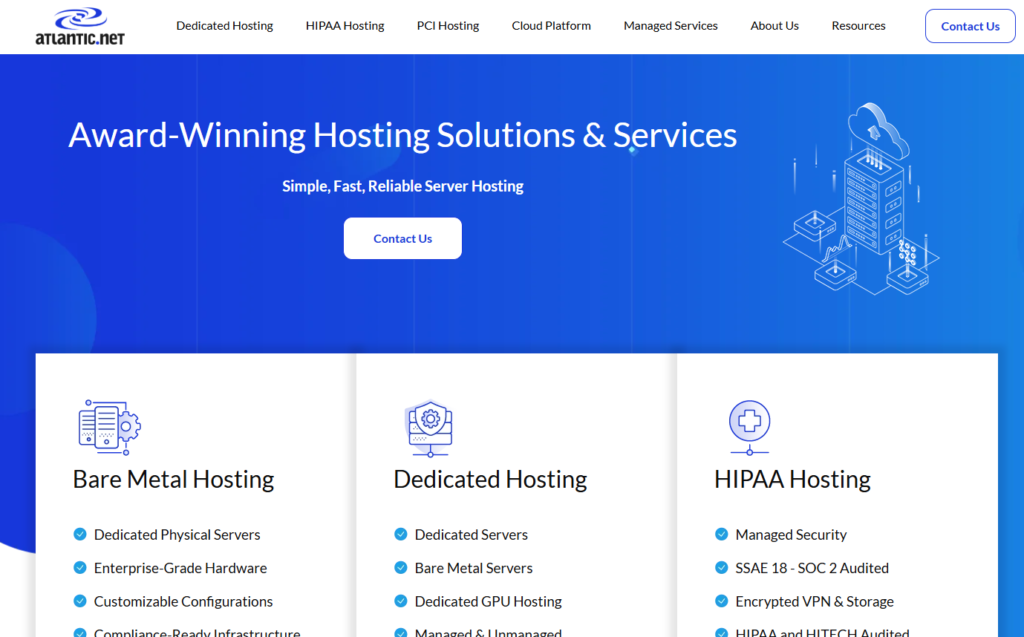
For businesses prioritizing performance and regulatory compliance, Atlantic.Net stands out with its dedicated bare-metal solutions.
These include high-end Intel Xeon and AMD EPYC configurations, options with 36 or 64 cores, SSD or NVMe storage, and robust bandwidth of 20 TB or more on 1 Gbps connections, often starting in the low $100s per month on promotional plans.
Atlantic.Net’s combination of support, compliance, and infrastructure makes it the most reliable choice for many organizations.
For workloads that are sensitive to availability, some providers offer a clear baseline with a 100% network and infrastructure uptime SLA, an uncommon feature at this pricing level.
These services are particularly well-suited for sectors such as healthcare, finance, and other regulated industries, where organizations are often required to provide audit trails and Business Associate Agreements.
Their data centers and hosting services support compliance with standards such as HIPAA, PCI DSS, SOC 2, and SOC 3, reassuring IT professionals and decision-makers in these sectors about security and reliability.
For storing Protected Health Information (PHI) or card data in certain countries, bare-metal solutions are available at data centers in key U.S. cities, including New York, Dallas, Ashburn, Orlando, and San Francisco. These options also extend to Canada, Asia, and Europe.
Where Atlantic.Net Excels:
Compliance-Ready Environments: Atlantic.Net has a proven track record and audit-ready infrastructure to support HIPAA, PCI, and SOC-aligned hosting needs.
They are experienced with financial systems that mandate strict data segregation, as well as healthcare applications such as EHRs, HL7/FHIR connections, and PACS image archives.
This demonstrates their reliability and builds confidence in their expertise.
Robust Out-of-the-Box Hardware: They offer a variety of pre-built plans with generous RAM and SSD/NVMe storage options, ranging from 6-core Xeon E-series processors to 64-core EPYC processors.
This makes it easy to tailor a strategy to specific databases, analytics, or AI workloads without starting from scratch.
Custom Builds and Scaling: If you can’t find what you need, they offer custom bare-metal configurations tailored to your workload, such as high-availability clusters, RAM-intensive configurations, or storage-heavy nodes.
24/7/365 U.S.-Based Support: Their support team is always available via phone and focuses on helping clients create compliant, high-availability solutions rather than merely restarting servers when issues arise.
If you’re seeking significant bare-metal performance, along with proper documentation, compliance, and a 100% SLA, Atlantic.Net is a solid choice. This is especially appealing to companies in healthcare, finance, or e-commerce that want bare-metal solutions without the risk of compliance issues or unexpected audits.
Hivelocity: Best For Global Bare Metal At Scale
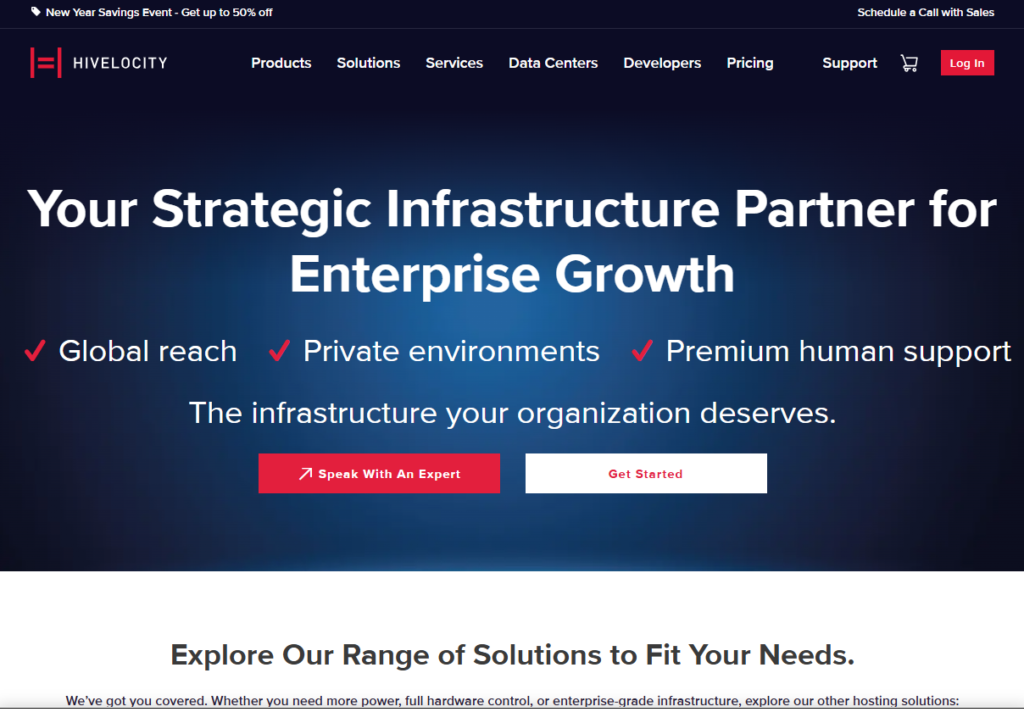
With over 50 global data centers, instant-deploy servers, and a robust API-driven platform, Hivelocity presents itself as the “bare metal cloud company.”
They enable single-tenant hardware to perform cloud-like functions, making it an excellent option if you prefer cloud-like orchestration alongside bare metal performance, particularly if you use tools like Terraform or Ansible for infrastructure management.
Where Hivelocity Shines:
Fast Provisioning: Most instant-deployment servers are ready in under 20 minutes, with popular configurations deployable in as little as 7 minutes.
This rapid provisioning can empower your team to scale campaigns or launch new services quickly.
Deep Automation: Hivelocity simplifies treating bare-metal as code with a robust REST API and integrations with tools such as Terraform and Ansible.
This enables version control of entire clusters and easy recreation as needed, eliminating the need for manual server ordering and configuration.
Global Footprint: Ideal for applications where proximity is crucial—such as gaming, streaming, ad tech, or SaaS—Hivelocity offers a low-latency presence throughout North America, Europe, and beyond.
24/7 In-House Support: Hivelocity employees staff its U.S. data centers—no outsourced support—ensuring practical capabilities such as drive swaps and private networking adjustments.
Where Hivelocity Might Fall Short:
Less Compliance Marketing Than Competitors: While it is possible to create secure, compliant environments, Hivelocity doesn’t emphasize compliance messaging (such as HIPAA or PCI) as much as Atlantic.Net or Liquid Web. This may require more internal oversight for design and documentation.
More Do-It-Yourself Architecture: Hivelocity is robust and adaptable, but is best suited for teams comfortable with configuring their own network topology, security measures, redundancy, and peering.
If you prioritize robust automation, rapid provisioning, and global reach, and want a compliance partner to guide you every step of the way, Hivelocity is a great option.
If you see “bare metal” as “another target in my Infrastructure as Code (IaC) repository” rather than a unique setup, then Hivelocity will meet your needs.
Liquid Web: Best Managed Bare Metal for Expanding Companies
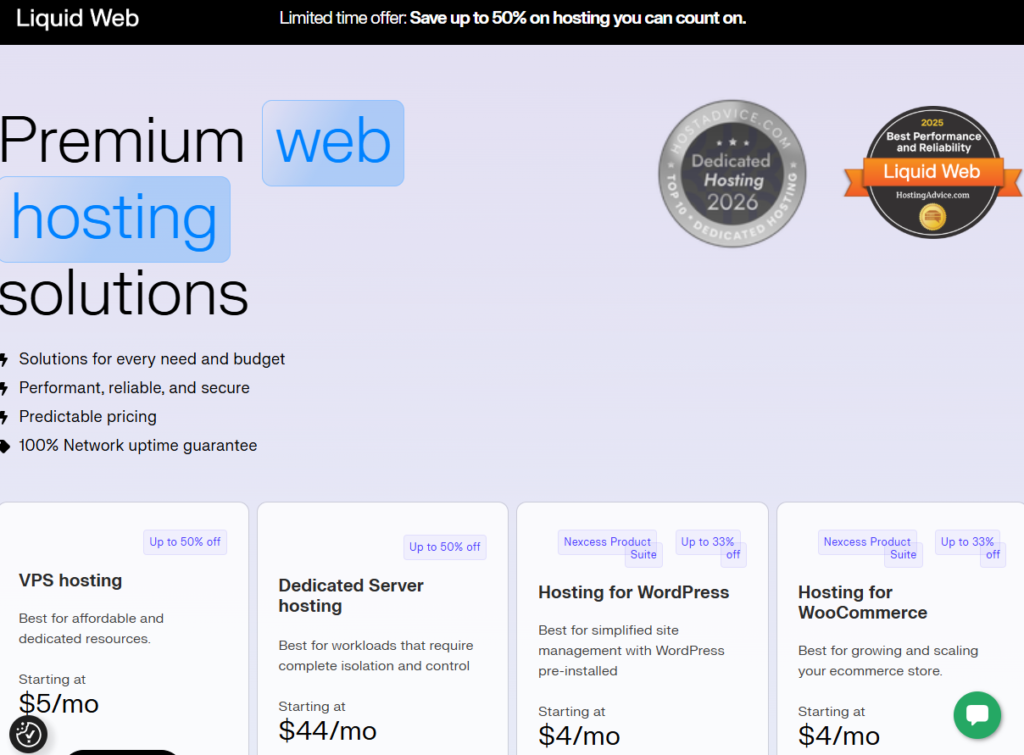
Bare Metal Servers from Liquid Web
Liquid Web offers bare-metal servers for clients who need dedicated hardware and comprehensive managed support. Their plans are distributed across multiple data center locations, ensuring strong geographic redundancy, and they use top-tier technology, including NVMe SSDs, current Xeon Gold processors, and high-bandwidth connections.
What sets Liquid Web apart is its focus on managed hosting. Instead of building an internal operations department that operates 24/7, you can delegate much of the system administration, monitoring, and backup tasks to their experienced staff. This can foster trust and peace of mind in your decision.
Where Liquid Web Excels:
Complete Single-Tenant Performance: Ideal for large databases, analytics workloads, and high-traffic applications that require consistent performance during traffic spikes and marketing campaigns.
You get a dedicated physical machine with direct hardware access and no virtualization layer.
Available Managed Services: If you want to focus on your core business rather than managing OS patches, security hardening, monitoring, and backups, Liquid Web offers managed service levels that handle these tasks.
This delegation reduces your team’s workload and can be more cost-effective than hiring additional infrastructure staff.
Compliance-Friendly: To help you navigate compliance easily, Liquid Web integrates bare-metal hosting with HIPAA and PCI solutions, focusing on use cases across industries such as retail, healthcare, and finance that require strict security and compliance.
Possible Limitations Of Liquid Web:
Higher Cost: Liquid Web’s services are priced at a premium due to their sophisticated infrastructure and managed support.
There are less costly options if you need to set up a large fleet of ephemeral nodes or if you’re primarily looking for a lower price per core.
Reduced “Pay by the Hour” Flexibility: Liquid Web’s contract and pricing structure are more traditional than those of bare-metal cloud platforms like PhoenixNAP.
This structure is better suited for long-running production applications but may not be ideal for temporary test clusters.
If you’re seeking bare-metal performance but also want a provider that handles most management, security, and support tasks, Liquid Web is a solid choice. It is especially recommended when uptime and peace of mind are more critical than squeezing every last penny out of your infrastructure bill.
OVHcloud: Best Value-Priced DDoS-Protected Bare Metal
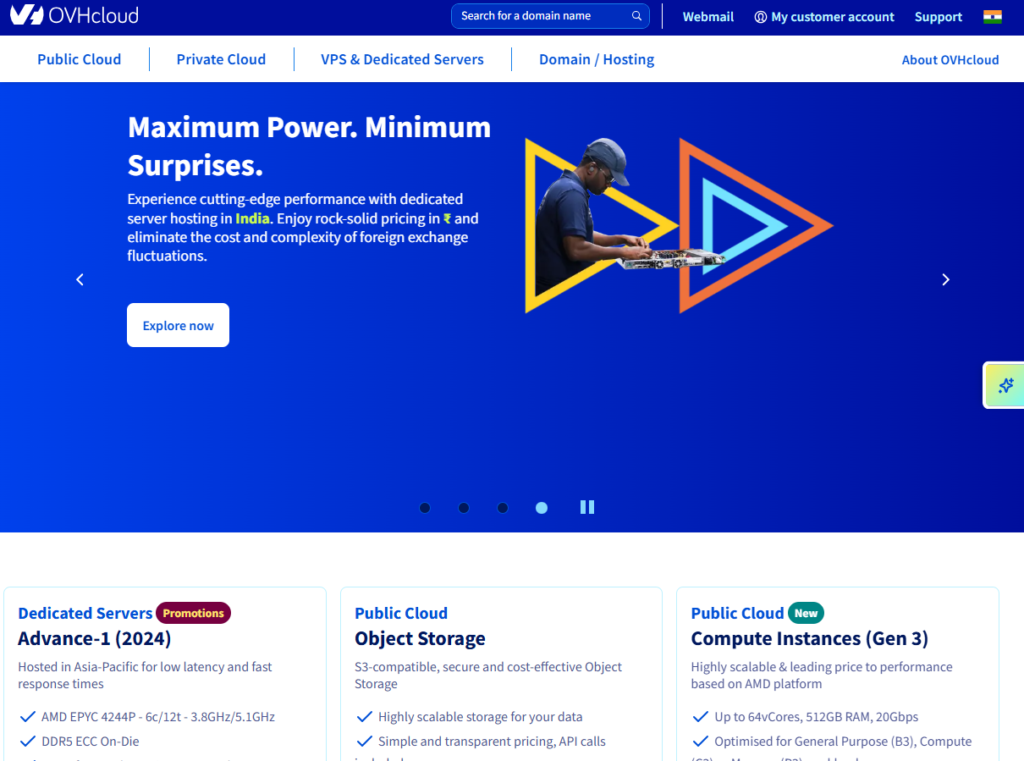
OVHcloud is one of the most recognized bare metal providers globally, particularly appealing to those on a tight budget. Their dedicated servers come with the following features:
- Built-in anti-DDoS protection optimized for frequent network-level attacks.
- SLAs vary by server type, with uptime ranging from 99.90% to 99.99%.
- Globally established data centers located in North America and Europe.
OVHcloud is particularly attractive for workloads vulnerable to DDoS attacks, such as gaming servers, public APIs, or high-profile applications, because it protects by default rather than as an additional add-on.
Where OVHcloud’s Strengths:
Included Anti-DDoS Protection: The platform’s built-in DDoS mitigation can handle very large attacks so that you won’t incur extra costs for it.
This is advantageous for running public gaming servers or SaaS applications that may attract unwanted attention online.
Good Price-to-Performance Ratio: Compared to premium managed providers in the US, OVHcloud’s pricing for dedicated and bare-metal servers is generally competitive, making it an attractive option that delivers good value for your investment.
IPv4 and IPv6 Support: Each server supports both IPv4 and IPv6, with the option to rent additional IPv4 addresses up to a specified limit. This feature is beneficial if you’re managing various services or clients.
Where OVHcloud May Fall Short:
Increased System Management Responsibilities: Expect to take on more responsibilities in system management, monitoring, and problem resolution as OVHcloud adopts a more “infrastructure-first” approach rather than a fully managed service.
Self-Managed Experience: Ideal for teams familiar with networking, automation, and Linux; may be less suitable for those who expect managed support similar to that provided by Liquid Web or Atlantic.Net.
Choose OVHcloud if you are comfortable managing and monitoring your own infrastructure and want reliable bare-metal servers with integrated DDoS protection at a competitive price.
PhoenixNAP: Best API-Driven Bare Metal Cloud with Hourly Billing
PhoenixNAP offers a Bare Metal Cloud platform that strikes a balance between public cloud and traditional dedicated hosting.
It provides bare-metal servers with flexible hourly or monthly billing, global locations, and provisioning via APIs, CLIs, and web user interfaces.
This makes PhoenixNAP appealing for AI workloads, CI/CD pipelines, ephemeral environments, and high-traffic applications that require rapid scaling. It empowers your team to adapt quickly to changing demands.
Where PhoenixNAP Excels:
Cloud-like Bare Metal Consumption: PhoenixNAP’s model enables flexible consumption, allowing businesses to scale resources quickly and efficiently based on workload requirements.
Feel free to reach out if you need any further adjustments or additional information!
Less traditional managed hosting is tailored for groups that prefer cloud-based operations and automation. Providers such as Liquid Web and Atlantic.Net are better suited for users who expect comprehensive management.
Complexity of Billing: While hourly and reserved pricing models can be effective, they require careful consideration of instance lifecycles and reservations to optimize costs, especially when multiple teams simultaneously spin up servers.
If you’re looking for actual bare metal with the agility of cloud services, especially for AI, big data, or unpredictable workloads where you don’t want to commit to long-term contracts for every server, consider PhoenixNAP.
Where phoenixNAP Could Fall Short
Less “traditional” managed hosting – It’s built for teams that want automation and cloud-style operations.
If a provider is expected to do everything, Liquid Web or Atlantic.Net will feel more familiar.
PhoenixNAP’s approach offers a modern, innovative alternative that can spark curiosity.
phoenixNAP offers both hourly and reserved pricing, which gives you flexibility. However, you need to manage your server instances carefully and reservations to keep costs under control.
This is especially important if multiple teams are deploying servers simultaneously.
Choose phoenixNAP if you want real bare-metal with the agility of the cloud—especially for AI, big data, or bursty workloads where you don’t want to commit to long contracts on every server.
This ensures you can rely on a stable and consistent infrastructure for critical workloads.
Hetzner: Europe’s Best Low-Cost Bare Metal
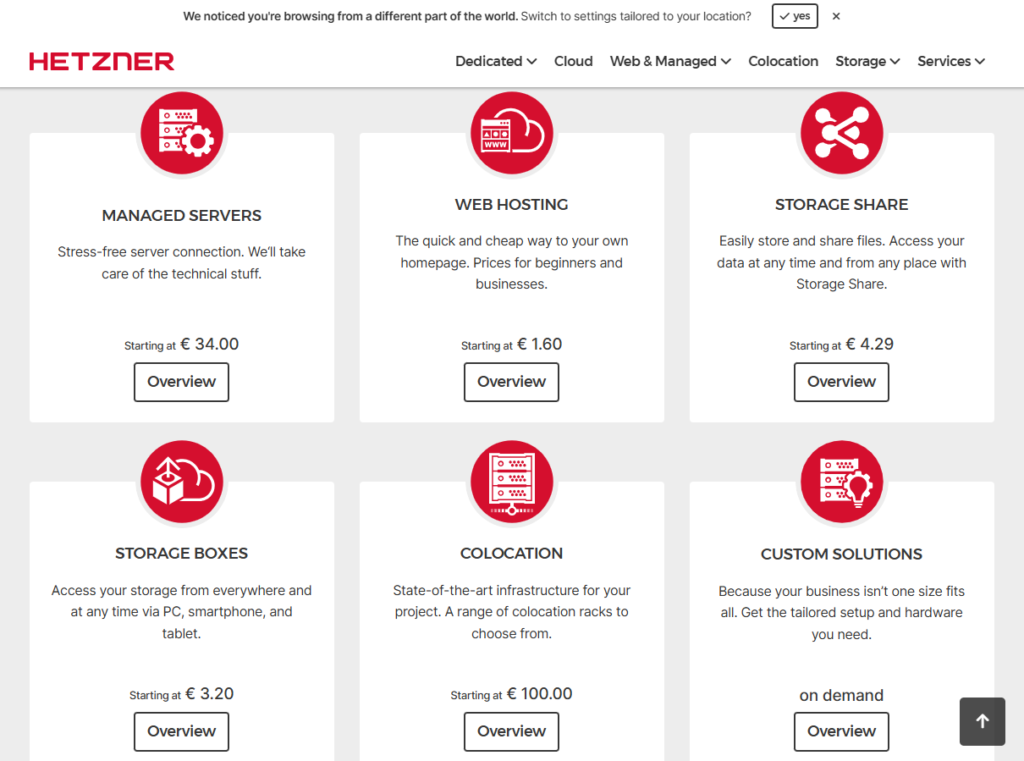
For those seeking cost-effective, high-performance dedicated servers in Europe, Hetzner stands out with powerful CPU, RAM, and storage options starting at approximately €37.30 per month.
This pricing makes it an attractive choice for developers, side projects, startups, and even substantial production workloads, particularly when cost-effectiveness, GDPR compliance, and EU data residency are essential.
Where Hetzner Excels:
Outstanding Price-to-Performance: Compared with major hyperscalers and managed hosting providers in the United States, Hetzner offers dedicated hardware at competitive prices in the European Union.
Diverse Server Lines: From durable production nodes to disposable test environments, Hetzner offers various server configurations—including EX, AX, RX, SX, GPU, and auction servers—allowing you to match hardware to your workload and budget.
EU-Based and GDPR-Friendly: An excellent choice if you require data residency in Finland or Germany and prefer to adhere to EU privacy laws.
Where Hetzner May Fall Short:
Primarily Europe-Focused: Without caching layers, CDNs, or a hybrid architecture, latency may be higher for users primarily in North America.
Less Support: Hetzner emphasizes self-service over extensive support, so it’s crucial to be comfortable managing infrastructure and troubleshooting at the operating system level.
Choose Hetzner if you’re looking for affordable, reliable bare metal in Europe, are willing to manage the infrastructure yourself, or have an effective DevOps strategy in place.
DigitalOcean: Over A Million Developers Choose DigitalOcean
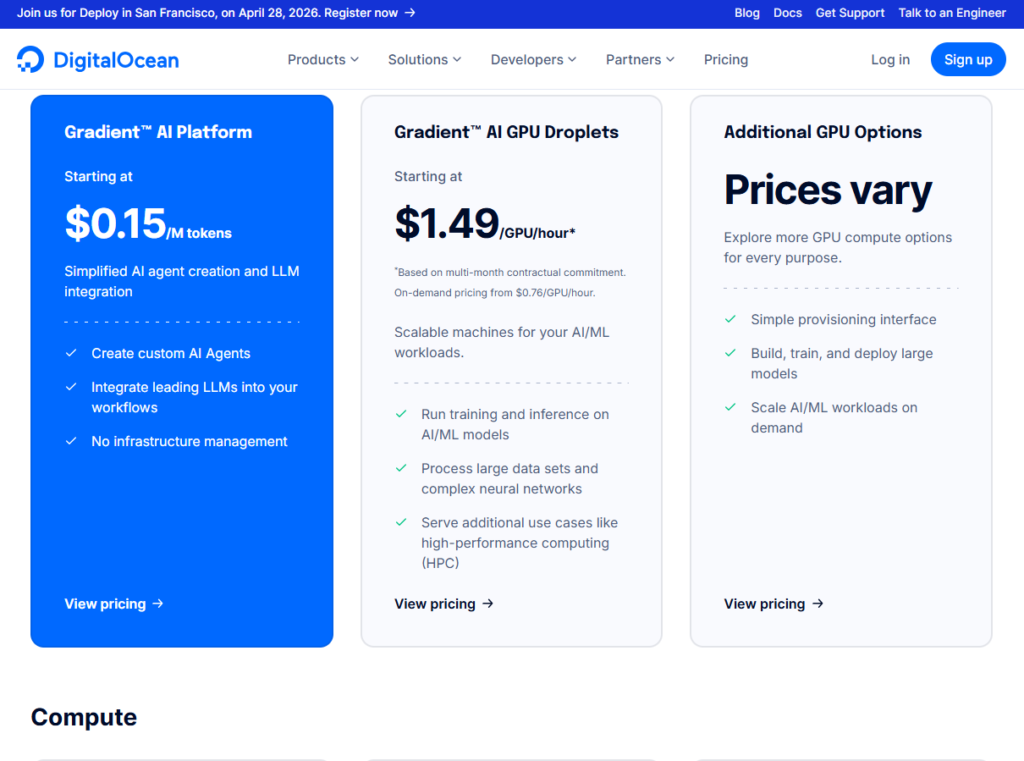
DigitalOcean is known for its flexible cloud infrastructure and also offers bare-metal options with its Droplets feature.
These dedicated servers are optimized for speed and simplicity, enabling developers to deploy projects efficiently.
With transparent pricing and a supportive community, DigitalOcean is a strong option for startups and developers seeking cost-effective solutions.
More than a million developers have chosen DigitalOcean for their infrastructure needs.
Developers can launch an SSD cloud server in under a minute and benefit from DigitalOcean’s flexible, high-performance infrastructure.
The platform’s dedicated servers, transparent pricing, and active community make it a leading choice for startups and developers focused on value.
How to Select the Best Bare Metal Hosting Provider
Choosing the right hosting provider can clarify your needs and reduce uncertainty in your decision-making. Remember, there is no one-size-fits-all solution for bare metal hosting.
Before committing to a multi-year contract or migrating your core databases, consider the following criteria:
Latency and Location:
Selecting data centers near your primary users—not just your internal team—can significantly reduce latency.
Verify actual round-trip times to your client locations, not just marketing claims, to ensure optimal performance.
For workloads focused on the United States, Atlantic.Net and Liquid Web are solid options; for Europe and beyond, consider OVHcloud, Hetzner, and PhoenixNAP.
If your infrastructure spans multiple regions, Hivelocity effectively serves both.
Compliance Support:
Prioritize providers who support compliance frameworks like HIPAA, PCI DSS, SOC 2/SOC 3, so you can manage regulatory requirements with confidence.
Liquid Web and Atlantic.Net provide dedicated, compliance-oriented hosting, and with the right setup, logging, and encryption, OVHcloud and PhoenixNAP can also support compliant infrastructures.
Control Versus Management:
Determine whether you need assistance with security, backups, or OS patches. Consider Liquid Web’s managed bare metal or Atlantic.Net’s managed services; these options are often best if you lack a full-time system administrator.
For maximum control and when working with infrastructure-as-code, Hivelocity, OVHcloud, PhoenixNAP, and Hetzner lean more toward self-management and integrate well with modern tools.
Scaling and Automation:
If you want to manage bare-metal servers with the agility of cloud services, prioritize API-driven providers such as Hivelocity and PhoenixNAP.
These enable infrastructure-as-code, rapid scaling, and the creation of temporary environments. Conversely, traditional monthly bare-metal from Atlantic.Net, Liquid Web, OVHcloud, or Hetzner may be more affordable and easier to budget for if your workloads are consistent and long-term.
Cost Model and Budget:
Expect to pay more for premium managed bare-metal hosting, but it can reduce staffing, on-call rotations, and recruitment costs (consider Atlantic.Net or Liquid Web).
If you prefer a hands-on approach, OVHcloud and Hetzner provide excellent value. For unpredictable or spiky workloads, PhoenixNAP’s bare-metal cloud on an hourly basis is ideal for pay-as-you-go pricing.
You’re frustrated with noisy neighbors or unexplained throttling following jitter or performance problems on VPS or shared cloud instances.
In a shared environment, gaining hardware-level control, such as specific CPUs, GPUs, or storage configurations, can be challenging or expensive, which is crucial for informed decision-making.
Strict isolation and complete stack visibility, including OS and firmware-level logging and patching, are essential for compliance and security. Your p95/p99 measurements highlight the overhead of virtualization, especially when you’re running AI/ML, big data, real-time analytics, or ultra-low-latency applications.
If this sounds familiar, start by comparing the bare-metal services offered by Atlantic.Net with those of one or two other companies that serve your location and budget.
Before committing important workloads to a platform that might be difficult to abandon, consider your management level, automation, and specific hardware requirements.
When Should You Transition To Bare Metal?
Consider transitioning to bare metal in the following situations:
Performance Issues: If you encounter jitter or lag on VPS or shared cloud platforms, bare-metal servers can improve reliability and efficiency to support essential IT requirements.
Hardware Control: If you require hardware-level control over CPUs, GPUs, or storage to meet project requirements, bare-metal provisioning provides this flexibility.
Compliance and Security: If you have strict compliance or security requirements, bare-metal provides isolation and full-stack visibility, enabling administrators to enforce security standards at the hardware level.
Resource-Intensive Applications: If you are running applications related to AI/ML, big data, or real-time analytics, or require ultra-low-latency performance, bare metal eliminates the virtualization overhead that can degrade your p95/p99 metrics.
If any of these scenarios apply, compare Atlantic.Net’s bare metal solutions with other providers that fit your budget and location.
Refine your options based on management, automation, and hardware needs before committing critical workloads to a platform that may be difficult to change later.
Checklist For Bare Metal Due Diligence (To Avoid Expensive Regret)
Most “bad bare metal” stories don’t stem from a slow CPU. They often involve unspoken limitations, unclear boundaries, and support that disappears when you need practical assistance.
This checklist will help you compare quotes and suppliers without any unpleasant surprises.
Quote-Level Information That Subtly Alters Actual Costs
Does bandwidth have a cap, is it “unmetered,” or does it include “X TB and then overages”? For data-heavy applications, overages can significantly increase costs.
Real throughput vs. port speed: A “1 Gbps port” doesn’t guarantee consistent throughput to end users. Consistent performance depends on peering and upstream capacity.
Are IPs included in the IPv4 cost model? How much does it cost to add more IPv4 addresses? Is there a strict upper limit?
What is covered by remote hands? Which services are charged for, and how quickly can issues such as drive swaps or cabling problems be resolved?
What is the hardware replacement policy? Are extra parts kept in stock? What is the guaranteed replacement timeframe?
Be aware of setup fees and contract terms; the risk profile for month-to-month versus annual or multi-year contracts varies significantly.
2 Questions About Support And Escalation (Often Overlooked)
Who is available after hours? Are they actual employees, or is there just a ticket queue with limited response?
What does “hardware support” entail? Request specific examples, such as IPMI issues, NIC failures, or disk/RAM replacements.
Can I access support by phone? Synchronous escalation is often more effective than asynchronous ticket threads during a service outage.
What is the escalation process? Understand how events are handled by a network engineer or on-site data center technician after passing through Tier 1.
Security And Compliance Questions That Cause Or Prevent Audit Issues
Clearly state security and compliance measures that directly impact your organization’s reliability. Responsibilities and controls should be explicit to reduce audit-related concerns.
Clarify the separation of responsibilities: OS/app controls and provider security controls must be clearly defined, not implied.
Logging and retention: Access, authentication, and change logs should be well documented, including their storage locations.
Understand patch expectations: How are firmware/BIOS upgrades scheduled, and who is responsible for them?
Baseline for payment environments: Even if the scope is later reduced, PCI DSS provides a helpful baseline for controls and expectations if cardholder data is involved. PCI Security Standards offers an overview.
Exit-Plan Questions (Migrations Are Harder Than They Seem)
Having a clear exit strategy is vital for reducing migration concerns. Understand how quickly you can leave and what costs or processes are associated with it, so you feel more secure in your choice.
How quickly can you exit the environment? Review the deprovisioning schedule, cancellation policy, and associated costs.
Consider the actual speed of transferring datasets across a network, not just theoretical port speeds, when assessing data egress.
Identify what could break during a relocation in an IP renumbering strategy. Before a stressful situation, ensure DNS cutover and TTL planning are in place.
Opt for a rebuild instead of an image restore. Migrations are more reliable when infrastructure as code is used.
Validation of Bare Metal: The Minimum Benchmark Pack (Before Finalizing)
Teams often spend more when migrating based on assumptions rather than actual performance improvements.
Running a small, repeatable benchmark suite on a fresh node helps verify whether p95/p99 latency stabilizes and improves relative to the current setup, supporting informed decisions.
Keep in mind that teams often incur higher costs when migrating based on intuition rather than achieving measurable improvements in tail latency.
This can be evaluated by running a series of lightweight tests, typically taking less than an hour to complete, on an otherwise idle system.
CPU Sanity (Quick): Use a widely known tool like sysbench, or run an internal load test if you already have one.
Disk I/O Baseline: Focus on random read/write patterns to assess performance effectively.
Following these guidelines will help you make informed decisions when selecting a bare-metal service and avoid common pitfalls.
How to Create a Website in 9 Easy Steps: Follow These Steps
How To Start A Business In 25 Easy Steps: Follow These Steps
BrandCrowd Review: Pros and Cons, Price & Features
Top 5 Best E-commerce Platforms: Compare and Rank
Hunter.io Review: Pros and Cons, How It Can Save Hours