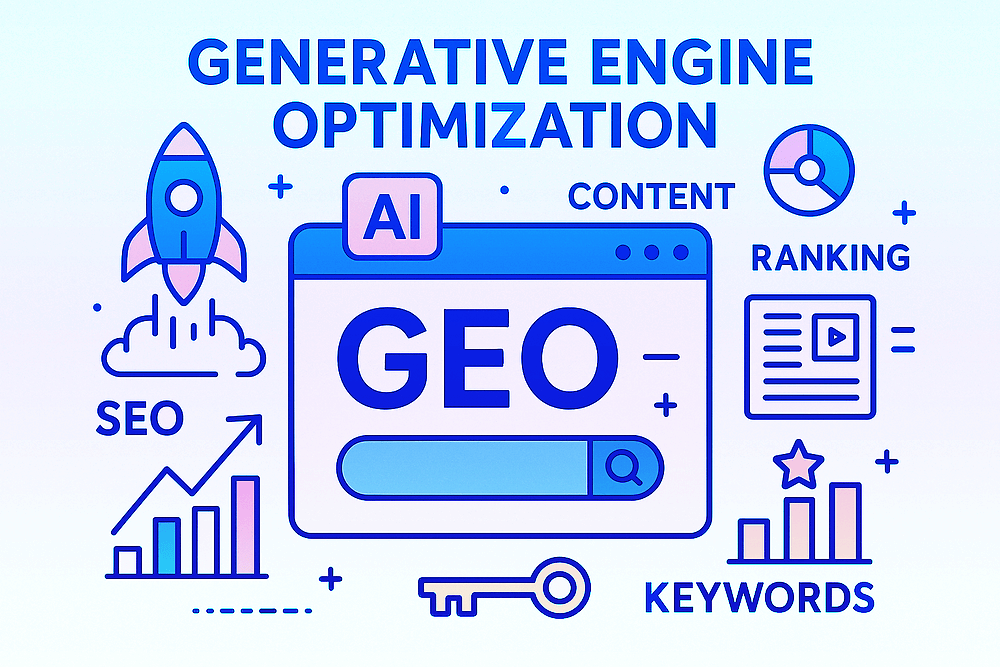





You can read the Generative Engine Optimization (GEO) Easy Playbook for Small Businesses and follow the step-by-step guide in the GEO Playbook, including GEO strategy, GEO vs. SEO, Why GEO Is Important Now, and much more here.
I may earn commissions from the links on this page since This Online Web is reader-supported. However, this does not influence my editorial judgments or opinions.
AI-generated responses are replacing long lists of search results. Users now ask questions such as “What’s the best [service] near me?” to AI systems like ChatGPT, Google’s AI Overviews, Perplexity, Gemini, and Claude.
These systems respond with a few brand recommendations, even to questions such as “For [use case], which [tool] is more reliable?”
To be included among recommended brands, implement generative engine optimization (GEO).
GEO aims to make your business a trusted source that AI systems summarize and cite, rather than just competing for organic rankings. If you already use traditional SEO and AI search, GEO is the next logical step.
This guide is designed for small and midsize businesses without substantial funding or a full-time SEO team that are already engaged in some SEO practices and are looking for a straightforward strategy to appear more frequently in AI Overviews and AI-powered responses.
In the following article, I will outline a practical GEO strategy that small businesses can implement within the next 30 to 60 days.
You can start showing up more often in AI responses without needing to hire an internal data team or purchase extensive corporate technology.
What Is Generative Engine Optimization (GEO)
Generative Engine Optimization (GEO) is the process of making your company more understandable, trustworthy, and citable through AI “answer engines.”
It’s about optimizing not only for Google or Bing search results, but also for:
- Google AI Overviews and AI Mode
- ChatGPT and other OpenAI-driven assistants
- Copilot, Claude, Gemini, and Perplexity
- AI-driven searches within social media platforms and applications
These programs crawl your website, local listings, review sites, Q&A forums, social media posts, and more.
They then aggregate this information into a few recommendations. GEO aims to ensure these recommendations align with reality, including your brand.
In essence, GEO is about being selected as the solution, while SEO (Search Engine Optimization) focuses on achieving higher search rankings.
GEO VS. SEO: How Rules Change For Small Businesses
The Differences Between GEO and SEO and Their Impact on Small Businesses
If you already invest in SEO, you’re halfway to adopting GEO. The primary differences lie in what you optimize for and how you measure success:
SEO: focuses on enhancing web pages to achieve higher rankings for targeted keywords, ultimately driving increased traffic to the website.
GEO: Optimizes your comprehensive online presence to ensure that AI assistants can effectively summarize, cite, and promote your brand, even when users do not visit your site directly.
Practically, this means small businesses should consider the following instead of just focusing on title tags and backlinks:
Clarifying what you do, where you operate, who you are, and who your audience is.
Creating pages that resemble structured answers rather than lengthy, unorganized blog entries.
Gaining third-party validation through reliable information from platforms like Yelp, G2, Google Business Profile, industry reviews, and specialist directories.
Enhancing your AI visibility, which refers to how often you are mentioned or cited in AI-generated responses beyond traditional search results.
For a deeper understanding, you can read my comprehensive analysis comparing SEO and GEO.
Why GEO Is Important Now, Especially For Small Businesses
Why GEO Is Crucial Now, Especially for Small Businesses
GEO is significant for three main reasons:
AI is becoming the go-to research tool for your buyers. More executives and consumers are using AI tools to suggest suppliers and evaluate options before conducting a traditional Google search or consulting colleagues.
AI overviews are now shown at the top of search engine results pages. Google frequently displays these before traditional organic listings, which may result in fewer clicks for top-ranking websites if they are not included in these overviews.
Answer engines prioritize reputation and clarity over size. You don’t need to be a well-known brand. However, an AI must be able to summarize and trust your company easily.
GEO presents a genuine opportunity for small businesses to stand out and succeed.
By refining your story, structuring your information, and enhancing your local footprint, you can confidently position yourself as the ‘obvious’ choice within AI-driven solutions—even as larger competitors focus on their resources.
The 30-Day GEO Playbook For Small Business Success
A clear, easy 30-day GEO plan can help you feel confident and motivated. You don’t need a complex roadmap—just a simple, manageable set of steps to start seeing results within a month.
This 30-day GEO playbook is structured into four weekly sprints. If your team is small, you can stretch this plan over 60 days while maintaining the same sequence.
A Short GEO Checklist For Small Businesses
Describe Your Entity
Provide an in-depth description of your business, including your name, location, and the services you offer.
Ensure Consistency Across Platforms
Verify that your website, Google Business Profile, and key directories all contain the same information.
Identify Key Buyer Inquiries
Determine ten to twenty relevant questions that your clients frequently ask, such as:
- “Nearest [your service].”
- “[Use case] best [your service].”
- “Inexpensive [your service] for [audience].”
- “[Competitor] alternatives”
- “Is [your brand] suitable for [circumstance]?”
Create Answer-Style Pages
For your top three to five inquiries, develop or revise answer-style pages to directly address client concerns. This increases your authority online.
Establish a Subject Hub
Create a basic subject hub for your primary service or product category.
Implement Schema Markup
Add the following schema markup to the following pages: LocalBusiness, Service, FAQPage, and Article.
Set Up SEO Tracking
Establish at least one SEO platform with AI search capabilities to monitor rankings and basic AI visibility.
Track Leads and Sales
Tag AI-intent landing pages in GA4 to track leads and sales effectively.
Week 1: AI Visibility Check And GEO Baseline

The first step is to understand what AI already assumes about your business.
1. Draft a List of Inquiries for AI Buyers.
Consider questions such as:
- “Nearest [your service].”
- “[Use case] best [your service].”
- “Affordable [your service] for [audience].”
- “[Competitor] substitutes”
- “Is [your brand] appropriate for [circumstance]?”
2. Ask those questions across the major AI engines you care about.
Use these queries in the primary AI engines that interest you:
- Google AI / AI Mode
- ChatGPT
- Bing Chat
- Gemini
- Claude (if available)
- Copilot on Bing
3. Document what you observe.
Document your observations for each question:
- Does your brand appear anywhere?
- If so, how is it portrayed?
- If not, which competitors are showing up?
- What URLs—yours or others’—are referenced?
You can do this manually in a spreadsheet or faster with an AI visibility tool. Find tools that enhance your current SEO stack with AI search tracking.
4. Label each query according to its importance.
Rank questions by significance using three labels:
- High-value: Direct customers or frequently discussed sales topics.
- Medium: Helpful but not crucial to your income.
- Low: Nice to have but not essential.
By the end of Week 1, you should understand your baseline AI visibility: where you are absent, where you play a minor role, and where you are the strong choice.
Week 2: Resolve Problems With Entities And Stories
GEO begins with a clear understanding of your identity. If your brand information is disorganized or inconsistent online, AI models will create their own version of your brand.
1. Standardize Your Entity Facts.
Choose one exact version for each category:
- Business name (exact spelling, no variations)
- Primary category (a clear description of what you do)
- Products or services you want to be recognized for
- Geography (city, region, or “serves clients worldwide”)
- Target audience (who you intend to serve)
2. Ensure those facts are accurate.
Check that the following details are correct:
- Your contact page, about page, and homepage
- Overview of your product or service
- Your Google Business profile
- Major review and directory sites (e.g., Natural directories, G2, Yelp)
A consistent entity makes it easier for AI systems to recognize and trust you. For additional information, see my guide, “How to Optimize Your Website for AI Search Engines.”
3. Refine your “who I am” story consistently across all contexts.
- Write a concise, one-sentence summary that states your core offering and target audience.
- Use this statement consistently across your website and external profiles.
- For example: “I do X for Y in Z place.”
Clear messaging helps generative algorithms generate accurate, consistent descriptions of your business.
Although it seems simple, this clarity helps generative engines create accurate, brand-consistent descriptions of your company, preventing confusion from outdated pages and random listings.
Week 3: Provide AI-Compatible Content That Serves As Direct Answers
Once your entity information is clear, the next step is to produce content that directly addresses the questions your ideal clients have when interacting with AI.
1. Transform your top 3–5 AI buyer questions into dedicated answer pages.
Create answer pages for your top three to five AI buyer questions to cater directly to client needs and enhance AI recognition.
These pages should focus on:
- “The best [service] for [audience] in [city].”
- “Options from competitors for [use case]”
- “How to select a [service] for [specific circumstance].”
Structure each page like a prewritten response:
- Use a clear H1 that mirrors the question.
- Provide a brief overview with a direct answer.
- List key points, steps, or justifications with bullet points.
- Address follow-up inquiries in the FAQ section.
My blog post format guidance ensures that AI assistants reference your content effectively.
2. Add a central “authority hub” for your main topic.
Create a single, comprehensive hub page for your main category, such as “Complete Guide to [Your Service].” This will serve as an essential resource on your website.
Link from that hub to:
- Your service pages
- Your educational blog posts
- Your FAQs and case studies
Improve the hub’s readability by including a table of contents, clear subheadings, and concise short-answer sections.
AI models favor this type of page because it’s simple to break down, summarize, and reference. It also helps establish your authority for visitors who arrive there.
3. Utilizing AI in Your Content Strategy
Purpose of AI: AI should be used to assist, not to generate irrelevant content. Utilize AI to create FAQs from sales notes, summarize customer interviews, and outline strategies that will help you feel more confident in your content approach.
Human Oversight: Every page should be reviewed by a human editor who understands your consumers’ feedback and assessments.
SEO Optimization: While optimizing for AI, ensure your pages also meet traditional SEO requirements. You can achieve this by using tools from a curated list of the best AI SEO tools, giving you confidence in your strategy.
Content Requirements: By the end of Week 3, aim to have several pages that closely align with the type of “source material” required by AI for confident suggestions.
Week 4: Implementing A Minimal Tool Stack And Adding A Technical GEO Signals
Many GEO guides become overly complicated at this stage. Instead of getting bogged down in theory, focus on a few practical, impactful actions as a small business.
1. Structured Data: Prioritize the inclusion of structured data.
Implement schema markup for:
- Your home page (local business or organization)
- Service pages (product or service)
- FAQ blocks (FAQPage)
- Guides and articles (blog posts)
If you’re not technically inclined, AI-friendly SEO plugins can automatically generate schema for you.
2. Think about adding an llms.txt file.
Like robots.txt, it tells large language models which parts of your website they can use for training or responses.
Allow access to your core content while keeping sensitive areas, such as customer dashboards, private.
This emerging convention resembles others but is tailored specifically for large language models.
It highlights the valuable sections of your website for training or answering questions. Some companies already use it to showcase their key AI resources.
Keep it simple: ensure your main content is accessible while safeguarding sensitive areas like customer dashboards.
3. Create a small, practical GEO tool stack that feels realistic and useful.
Create a manageable stack of GEO tools to help you handle local SEO without feeling overwhelmed.
You don’t need ten different tools. A basic GEO tool stack for most small teams might include:
An SEO + AI platform to manage essentials like keyword tracking, on-page audits, and AI search visibility.
A tool to check how often you’re mentioned on ChatGPT, Perplexity, and Google AI, as many of these now incorporate basic GEO functions within their SEO or analytics suites.
A combination of analytics and basic reporting using GA4, along with a dashboard or spreadsheet to monitor:
- Visits to pages with AI intent (based on landing page lists or URL patterns)
- Sales, leads, or demos generated from that market
For a comprehensive breakdown, refer to the guide on the best AI stack for small businesses.
GEO Strategies Based On Business Type
The main ideas stay the same, but how you use them depends on your product and how your customers buy.
Local Service Businesses Such As Health, Legal, And Home Services:
Focus on local visibility. Ensure your Google Business Profile, schema, and entity description clearly highlight your location and service area.
Create hub pages like “Best in [City].” For example: “Best Family Dentist in Phoenix:
How to Choose and Why Patients Pick Us,” which serves as a strong regional reference for both consumers and AI.
Collect review material that leads customers to describe specific issues you solved.
Instead of simply saying “great service,” encourage phrases like “fixed our AC the same day during a heat wave.” This mimics how humans form requests to AI.
For example, a small HVAC company in a mid-sized city could publish a guide titled ‘Best AC Repair in [City] During Heat Waves,’ covering response times, emergency costs, and common issues.
Linking this guide from your main service page and Google Business Profile establishes it as a trusted resource for both users and AI.
E-commerce Stores Online Retailers:
Optimize comparison and category pages for AI. Use concise bullet points and FAQs to directly answer the question, “What is the best [product type] for [use case]?”
Standardize product features and specifications. Consistent, structured data is crucial for generative engines. Utilize spec lists and clean tables for easy comparison.
Demonstrate your expertise in specialized topics by creating content hubs. For example, ‘The Complete Guide to Hiking Backpacks for Weekend Trips’ can link to different models.
An online store focused on hiking gear could create a hub titled “Best Hiking Backpacks for Weekend Trips,” analyzing weights, sizes, and applications.
This page would serve as a clear source for AI systems seeking concise, up-to-date answers on the “best weekend hiking backpack.”
Concentrate on B2B and SaaS digital Presence
Take control of your narrative regarding “[Competitor] alternatives.” Create clear and organized comparison pages that highlight both your strengths and weaknesses.
Tailor your answer pages to specific use cases. AI tools perform excellently with detailed scenarios, such as “[Product] for multi-location clinics” or “[Product] for remote sales teams.”
Ensure your GEO (Generative Engine Optimization) efforts align with your success and sales goals.
Reflect the actual language of your customers by basing your answer pages on recorded calls and real sales inquiries.
For example, a SaaS business competing with a popular CRM might create pages like “Best [Competitor]
Alternatives for Agencies” and “Best [Competitor] Alternatives for Remote Sales Teams,” each outlining unique advantages, disadvantages, and migration procedures.
If someone asks, “What are good alternatives to [Competitor] for a distributed sales team?” AI assistants should be able to include you in their responses easily.
Common GEO Mistakes Small Businesses Make
Understanding that GEO is an ongoing process can help small businesses avoid typical errors.
Emphasizing continuous effort allows companies to stay focused and avoid common pitfalls.
While you can achieve significant advancement with GEO, a few traps might waste time or have adverse effects:
Treating GEO as a checklist. Remember that search interfaces and AI models are always evolving. GEO is a continuous journey rather than a one-time project.
Over-automated content. Excessive automation can damage your credibility with both users and search engines.
Use AI as an assistant, not a replacement for your voice, to ensure authenticity.
Ignoring your current SEO framework. Overlooking your SEO strategies can impede GEO success.
By integrating GEO with strong SEO practices, you enhance overall visibility, making your website faster, clearer, and richer in content, which benefits your business in both traditional and AI-driven search environments.
Chasing after every new tool. For most small teams, a basic AI visibility tracker and a couple of AI SEO tools are sufficient. Adding more tools than you can effectively use can be a major distraction.
FAQ About Generative Engine Optimization (GEO)
Is SEO just another term for SEO?
No. While SEO is the foundation, GEO focuses on how AI-powered “answer engines” like Google AI Overviews, ChatGPT, and Perplexity understand and suggest your business.
Traditional rankings remain important, but GEO ensures visibility within new AI experiences.
What is the typical turnaround time for GEO?
If your SEO foundation is strong, you should see initial movement within 30 to 60 days as AI tools re-index your updated pages and profiles.
As you continue to produce answer-style content and strengthen your entity signals, more significant and lasting benefits typically become apparent after several months.
Do you need expensive corporate tools for GEO work?
Not at all. Most small teams can begin with a single SEO platform that includes GA4, a lightweight AI visibility checker, and basic AI search functionality.
Rather than acquiring every new GEO tool, the real advantage lies in how well you structure your content and represent your business clearly.
Is GEO only for SaaS, or can it help local businesses?
GEO is especially vital for small businesses. AI systems already suggest nearby services like dentists, plumbers, lawyers, and restaurants.
If your entity data is disorganized or your city and services aren’t clearly explained, these systems will prioritize larger brands or generic directories over you.
Start with one high-intent query, like “best [service] in [city].” Ask it in ChatGPT and Google AI Overviews, and create a clear, organized page that addresses the query.
This foundational step can boost your confidence in utilizing GEO effectively.
Maintaining GEO Operations Without Burning Out
After using the 30-day playbook once, GEO can become a habitual part of your routine marketing tasks:
Monthly: Update your baseline spreadsheet and review a few key AI tool prompts.
Every three months: Refresh your hub content and main answer pages according to new inquiries, features, or pricing changes.
Twice a year: Audit the consistency of your entity information across your website, Google Business Profile, and key directories.
Ongoing: Continue to produce AI-friendly content without compromising your brand voice by following the guided procedures in the AI content workflows guide.
You don’t need to outpace all your online competitors. Instead, aim to be the most straightforward and reliable business for AI systems to recommend when your ideal client requires assistance. By doing so, you will future-proof your visibility before others catch on.
Some Important Points in this Article: Read These Steps Carefully
What is Generative Engine Optimization?
Generative Engine Optimization (GEO) is an innovative approach that merges search engine optimization (SEO) with artificial intelligence.
It focuses on using AI tools to improve content creation and sharing. Below are some important points about GEO.
GEO focuses on strategies to increase the visibility and effectiveness of generated content in search engine results.
It involves using AI to create high-quality, relevant content that matches user needs and complies with search engine guidelines.
Why is GEO Important?
Scalability: GEO helps businesses create content quickly and efficiently.
AI tools can quickly generate blog posts, articles, and product descriptions, making it easier for companies to keep their websites active.
Generative models use machine learning and natural language processing to produce content that closely aligns with users’ preferences.
This can help improve search rankings. Ratios can significantly reduce marketing costs, enabling businesses to allocate resources more effectively.
Key Elements Of GEO
Keyword Optimization: Add relevant keywords and phrases to generated content to match search intent and boost visibility.
User engagement entails developing content that performs well in search engine rankings and keeps users interested. This approach can reduce bounce rate and increase conversions.
Technical SEO: Ensure generated content adheres to technical SEO best practices, including proper tags, schema markup, and fast load times.
Continuous improvement means using analytics and user feedback to update content strategies. This helps generative models better meet user needs over time.
Challenges Of GEO
Quality control is important to make sure AI-generated content is high-quality and relevant.
Low-quality content can harm a website’s reputation and lower its search rankings.
Search engines frequently revise their algorithms, affecting how they evaluate AI-generated content.
Staying up to date with these changes is key to good SEO.
To maintain originality in content, it’s crucial to strike a balance between incorporating new ideas and utilizing existing information.
This helps avoid duplicate content and search engine penalties.
Future Of GEO
As AI technology advances, Generative Engine Optimization (GEO) is expected to improve, creating new opportunities for businesses to connect with their target audiences.
Marketers should stay up to date on technological advancements and best practices to fully leverage GEO’s potential.
By adding GEO to their digital marketing plans, businesses can improve content creation, enhance SEO performance, and achieve greater success online.
Top 7 Best Bare Metal Hosting Services: Easy Steps
How to Create a Website in 9 Easy Steps: Follow These Steps
8 Best Email Marketing Services for Small Businesses
How To Start A Business In 25 Easy Steps: Follow These Steps
3 Best PEO Services Providers for Small Businesses
For More on this article, you can check out the external links